
Sensors And Modules
Showing 1–15 of 158 resultsSorted by popularity
- Boards, Modules and Accessories, Sensors And Modules
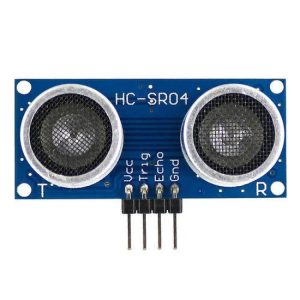
HC-SR04 Ultrasonic Distance Sensor Module
– Accurate non-contact distance measurement from 2 cm to 400 cm
– High precision with up to 3 mm resolution
– Uses 40 kHz ultrasonic waves for reliable detection
– Easy 4-pin interface (VCC, Trig, Echo, GND); Arduino and Raspberry Pi compatible
– Fast response time (<10 ms) and low power consumption (15 mA)
– Compact, lightweight, and cost-effective for robotics, automation, and DIY projectsSKU: n/a - Boards, Modules and Accessories, Sensors And Modules
IR Infrared Obstacle Avoidance-Line Follower Sensor Module
 Boards, Modules and Accessories, Sensors And Modules
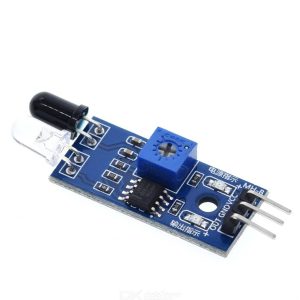
IR Infrared Obstacle Avoidance-Line Follower Sensor Module
– Dual functionality: obstacle avoidance and line following in a single IR sensor module
– Adjustable sensitivity via onboard potentiometers for different surface types
– Digital output (high/low) for easy microcontroller integration
– Compact, lightweight design with multiple mounting holes for robotics
– Wide operating voltage: compatible with 3.3V to 5V systems
– Ideal for robotics, AGVs, industrial automation, and DIY projectsSKU: n/a - Boards, Modules and Accessories, Sensors And Modules
5V 1-Channel Arduino Relay Module Board
- Compact 1-channel relay module with 5V DC control for microcontrollers.
- SPDT (NO/NC) relay supports up to 10A at 250V AC or 10A at 30V DC.
- Optocoupler isolation protects your Arduino, Raspberry Pi, or ESP board.
- Built-in LED indicator and screw terminals for easy wiring and status monitoring.
- Compact 52 x 26 x 18 mm PCB with mounting holes for tight enclosures.
- Ideal for home automation, DIY projects, industrial controls, and automotive applications.
SKU: n/a - Batteries, Cells and Power Supply, Sensors And Modules
Li-ion Lithium Battery Charging Protection Module Type-C (TP4056)
Batteries, Cells and Power Supply, Sensors And ModulesLi-ion Lithium Battery Charging Protection Module Type-C (TP4056)
- Single-cell Li-ion/LiPo charger ideal for DIY and portable projects
- Integrated protection: overcharge, over-discharge, short circuit, reverse polarity
- Micro USB 5V input for easy charging from standard USB adapters
- LED indicators show charging and full-charge status
- High-efficiency TP4056 IC with low heat generation, up to 1A charge current
- Compact, lightweight board for power banks, LED projects, and small electronics
SKU: n/a - Sensors And Modules
4×4 Numeric Membrane Switch Keypad Matrix Module
– 4×4 matrix numeric keypad with 16 tactile keys (0-9, A-D, *, #)
– Soft click feedback and durable flexible membrane
– Easy 8-pin header connection for Arduino and Raspberry Pi
– Works from 3.3V to 5V for broad microcontroller support
– Compact size (approx. 70mm x 77mm) ideal for panels and breadboards
– Lightweight and easy to integrate into DIY, automation, and security projectsSKU: n/a - Boards, Modules and Accessories, Sensors And Modules
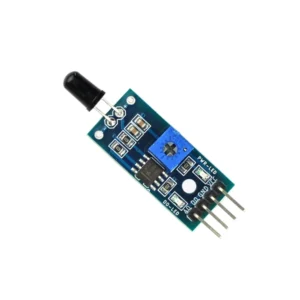
IR Infrared Flame Sensor Module
– Fast IR flame detection using infrared sensing technology
– Operates on 5V to 12V for broad compatibility
– Both analog (AO) and digital (DO) outputs for flexible integration
– Adjustable sensitivity with onboard potentiometer
– Compact, lightweight design for tight installations
– Ideal for fire alarms, robotics, home automation, industrial safety, and educationSKU: n/a - Boards, Modules and Accessories, Sensors And Modules
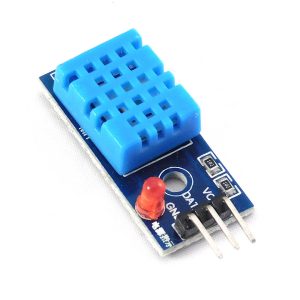
DHT11 Temperature & Humidity Sensor Module
– Dual measurement: temperature and humidity in a single compact module
– Digital single-wire output for easy microcontroller integration
– Reliable accuracy: ±2°C temperature and ±5% RH humidity
– Wide measurement range: 0°C to 50°C and 20% to 90% RH
– Low power consumption ideal for battery-powered projects
– Pre-calibrated and ready to use out of the boxSKU: n/a - Resistors, Capacitors, Inductors etc., Sensors And Modules
Photoresistor LDR Light Dependent Resistor Module
Resistors, Capacitors, Inductors etc., Sensors And ModulesPhotoresistor LDR Light Dependent Resistor Module
– Precise ambient light detection with an LDR photoresistor
– Both analog (AO) and digital (DO) outputs for flexible interfacing
– Easy to integrate with Arduino, Raspberry Pi and other microcontrollers
– Low power consumption, ideal for battery and solar-powered systems
– Compact, lightweight design for space-constrained projects
– Perfect for automated lighting, solar devices, robotics and IoT applicationsSKU: n/a - Boards, Modules and Accessories, Sensors And Modules
MPU6050 GY521 3-Axis Gyroscope Accelerometer Module
Boards, Modules and Accessories, Sensors And ModulesMPU6050 GY521 3-Axis Gyroscope Accelerometer Module
- 6-axis motion tracking: Integrated 3-axis accelerometer and 3-axis gyroscope for full motion sensing.
- 16-bit precision: High-resolution ADCs deliver accurate acceleration and rotation data.
- Compact and lightweight: Small 20mm x 16mm form factor and 0.5 g weight for easy integration.
- Easy I2C integration: Standard I2C interface (up to 400 kHz) with selectable address and wide 3.3V–5V support.
- Built-in DMP and interrupts: Onboard Digital Motion Processor and configurable interrupts for efficient motion processing.
- Versatile use cases: Ideal for drones, robotics, wearables, gaming controllers, and motion capture systems.
SKU: n/a - Boards, Modules and Accessories, Sensors And Modules
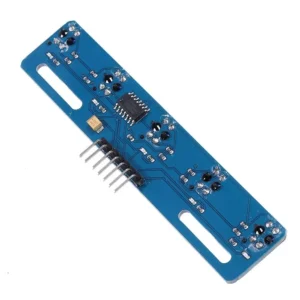
TCRT5000 5-Channel IR Sensor Line Tracking Module
Boards, Modules and Accessories, Sensors And ModulesTCRT5000 5-Channel IR Sensor Line Tracking Module
– 5-channel TCRT5000 IR sensor module for reliable line tracking
– Fast infrared detection ideal for racing and maze-solving robots
– Simple pin labels and Arduino compatibility for quick setup
– Compact, lightweight design for easy mounting on robot bases
– Accurate detection of black lines on white surfaces for smooth control
– Perfect for DIY projects, robotics competitions, and automation prototypesSKU: n/a - Boards, Modules and Accessories, Sensors And Modules
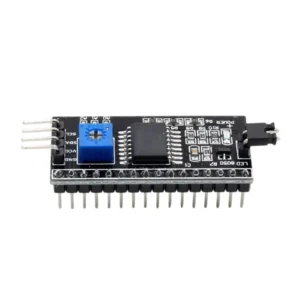
PCF8574 16 Pin I2C LCD Display Module
– Connect 16×2 or 20×4 character LCDs using only four pins (VCC, GND, SDA, SCL)
– Reduces wiring and saves up to 6 GPIO pins compared to parallel LCD wiring
– Built-in PCF8574 I/O expander for stable I2C communication
– Adjustable contrast via onboard potentiometer and software-controlled backlight
– Compact, plug-and-play design that fits behind the LCD
– Compatible with Arduino, Raspberry Pi, ESP32 and major development boardsSKU: n/a - Boards, Modules and Accessories, Sensors And Modules
Joystick Module Dual Axis XY Analog Module
– Dual-axis joystick for precise X and Y control
– Easy integration with Arduino and common microcontrollers
– Analog potentiometer outputs for smooth, real-time input
– Compact, durable design for long-term use
– Ideal for robotics, RC vehicles, gaming and interactive DIY projects
– Affordable solution for hobbyists, students and makersSKU: n/a - Boards, Modules and Accessories, Sensors And Modules
TCRT5000 IR Reflective Sensor Photoelectric Switch
Boards, Modules and Accessories, Sensors And ModulesTCRT5000 IR Reflective Sensor Photoelectric Switch
- Compact IR reflective photoelectric sensor in a 4-pin package
- Built-in IR LED and phototransistor for reliable short-range detection
- Detects object presence and surface contrast (black/white) for line following
- Typical detection distance up to 15 mm depending on surface
- Low power consumption and high sensitivity for robotics and automation
- Ideal for hobbyists, students, and embedded systems projects
SKU: n/a - Sensors And Modules
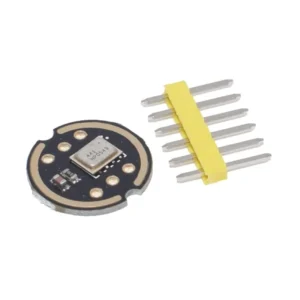
INMP441 High Precision Omindirectional Microphone Module
– INMP441 MEMS digital microphone for high-quality audio capture
– Omnidirectional 360° pickup for consistent sound from all directions
– Direct I2S digital output (no external ADC required)
– High SNR (~61 dBA) and wide frequency response (60 Hz to 15 kHz)
– Compact, low-power design ideal for battery-powered IoT devices
– Compatible with ESP32, Raspberry Pi, and other I2S-supported MCUsSKU: n/a - Sensors And Modules
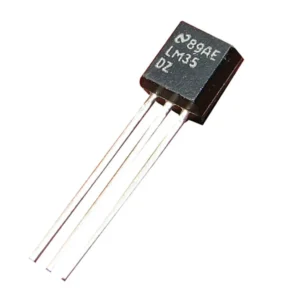
LM35DZ Temperature Sensor
- Linear Celsius output: 10mV per °C for direct temperature readings
- High accuracy: ±0.5°C at 25°C for reliable measurements
- Operating range: 0°C to 100°C; supply 4V to 30V
- Low power consumption: typically less than 60µA to minimize self-heating
- Compact TO-92 package for easy mounting in circuits
- No external calibration required; simple integration with microcontrollers
- Compatible with Arduino, Raspberry Pi, PIC, AVR, and other microcontrollers
SKU: n/a






Which Sensors and Modules are best for common Arduino or Raspberry Pi projects?
The best module depends on what you want to measure or control. For distance, the HC-SR04 Ultrasonic Distance Sensor Module is a popular choice. For line following or obstacle avoidance, the IR Infrared Obstacle Avoidance-Line Follower Sensor Module works well. For temperature and humidity, use the DHT11 Temperature & Humidity Sensor Module. To switch higher-power devices, the 5V 1-Channel Arduino Relay Module Board is ideal. For light sensing, the Photoresistor LDR Light Dependent Resistor Module is a simple option. If you need flame detection, the IR Infrared Flame Sensor Module is suitable. For battery projects, the Li-ion Lithium Battery Charging Protection Module Type-C (TP4056) handles charging and protection. For user input, the 4x4 Numeric Membrane Switch Keypad Matrix Module adds a keypad. All these modules work with Arduino, ESP32, and Raspberry Pi. If you are unsure, read our guide on how to choose the right sensor for your Arduino or ESP32 project.
What should I check before buying Sensors and Modules?
Before buying, check voltage compatibility, output type, and whether the module needs extra components. Most modules here work with 3.3V to 5V logic, but always confirm. For example, the DHT11 operates at 3.3V to 5V, while the flame sensor supports 5V to 12V. Output type matters: analog sensors give a varying voltage, digital sensors give high or low. Some modules have both, like the LDR and flame sensor. Also consider mounting: most modules have mounting holes for robotics. If you need help, our team can guide you. We deliver nationwide across Pakistan with flat-rate shipping Rs 350. Prices start from Rs. 60 and were checked in September 2026.
Frequently Asked Questions
What is the difference between a sensor and a module?
A sensor is the raw component that detects a physical change, like an LDR or thermistor. A module adds supporting circuitry, pins, and sometimes an LED or potentiometer, making it easier to connect to a microcontroller. For example, the DHT11 module includes a pull-up resistor and a 3-pin header, so you can plug it directly into an Arduino without extra parts.
Can I use these Sensors and Modules with Raspberry Pi?
Yes, most modules work with Raspberry Pi if they operate at 3.3V or 5V and use digital or analog outputs. The HC-SR04, DHT11, and relay module are commonly used with Raspberry Pi. Always check the logic level: Raspberry Pi GPIO pins are 3.3V, so use a level shifter if a module outputs 5V signals.
Do you offer warranty on Sensors and Modules?
We do not list a specific warranty for these modules. If you receive a faulty item, contact us within a reasonable time and we will help. Our focus is on providing tested, working components. For any issue, reach out to our support team and we will resolve it.
How fast is delivery for Sensors and Modules in Pakistan?
We deliver nationwide across Pakistan with flat-rate shipping Rs 350. Delivery time depends on your city. Orders are processed quickly, and you will receive tracking information. For urgent projects, contact us to check current dispatch times.
Can I get help choosing the right module for my project?
Yes, our team at College Road Electronics in Rawalpindi can guide you. We help students and hobbyists pick the right Sensors and Modules for their Arduino, ESP32, or Raspberry Pi projects. Visit our shop or contact us online with your project details, and we will suggest suitable options.
What are Sensors and Modules and how do I choose?
Sensors and Modules are electronic components that measure physical changes or add functions to your microcontroller. Choose based on your project: distance, light, temperature, or switching. At College Road Electronics, prices range from Rs. 60 to Rs. 250, checked September 2026.
About Sensors and Modules
Sensors and modules are the foundation of electronics projects, robotics, and automation systems. Ultrasonic distance sensors like the HC-SR04 provide accurate range measurement, while infrared modules are commonly used for obstacle avoidance and line-following robots. Relay modules enable safe switching of high-power devices, and voltage sensors monitor electrical levels in real time. Specialized tools such as thermocouples measure temperature, flame sensors detect fire hazards, and joystick modules bring interactive control to robotic systems. With additional components like I2C adapters for LCDs and LED traffic light modules for learning circuits, these modules offer versatility, reliability, and ease of integration into both beginner and advanced projects.
FAQs
Q1. How does the HC-SR04 ultrasonic sensor measure distance?
It sends out ultrasonic waves and calculates distance by measuring the time it takes for the waves to bounce back after hitting an object.
Q2. What is the purpose of the I2C module for LCD displays?
The I2C adapter reduces the number of pins required to connect an LCD to a microcontroller, simplifying wiring and freeing up resources for other components.
Q3. Where is a flame sensor module commonly used?
It is often used in fire-detection systems, safety alarms, and robotics projects where flame detection is required for safety or automation.
Q4. Can the TCRT5000 IR sensor module track multiple lines?
Yes, the 5-channel version can track multiple lines simultaneously, making it suitable for line-following robots with complex navigation paths.
Q5. What is the function of a relay module in electronics projects?
A relay module acts as a switch controlled by a low-power signal from a microcontroller, allowing safe control of higher voltage devices like fans, lights, or pumps.