
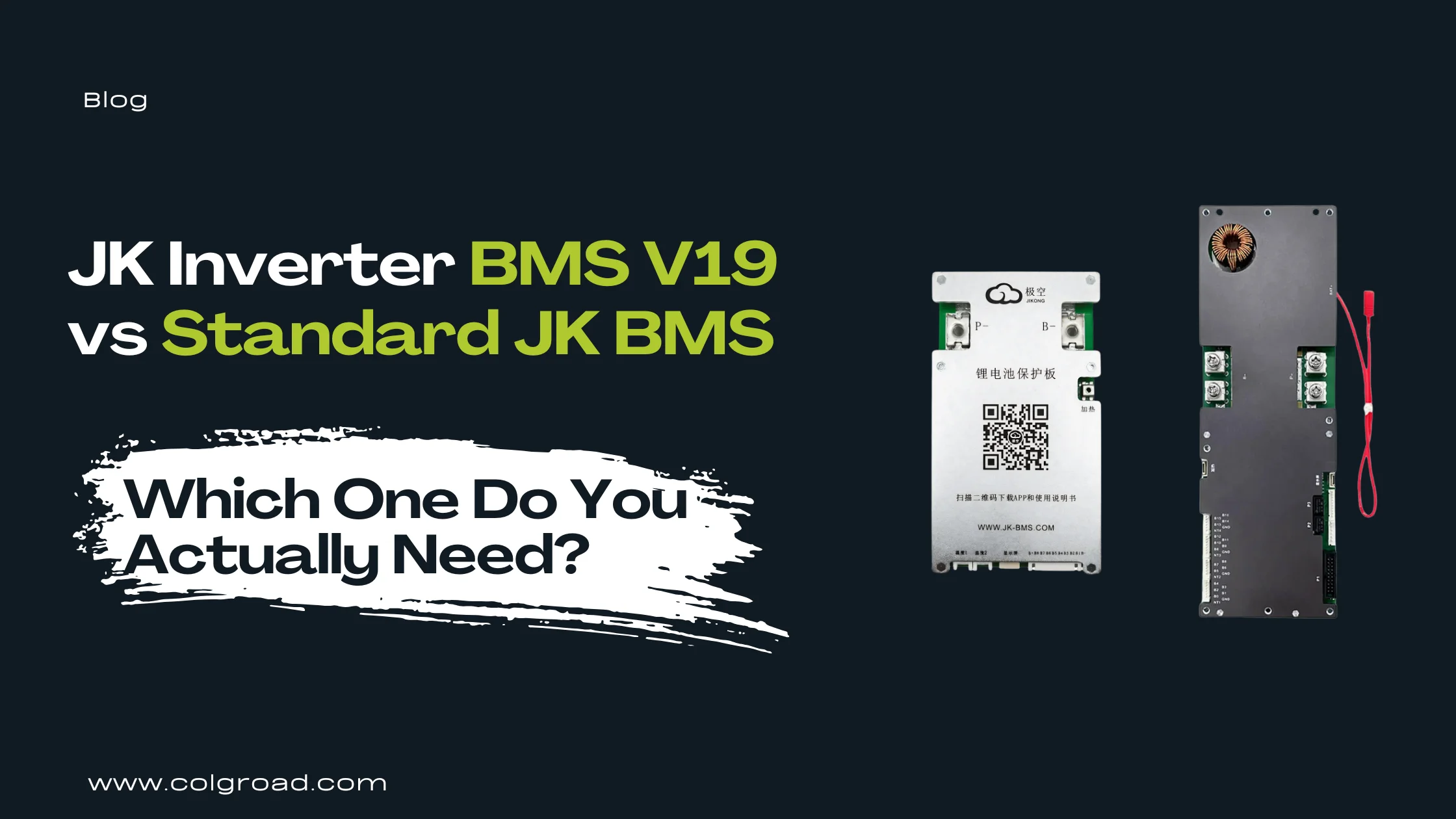
If you've spent any time researching a smart BMS for your lithium battery build in Pakistan, you've likely run into two confusingly similar product lines from JK BMS (JIKONG): the standard JK BMS (B-series) and the JK Inverter BMS V19 (PB-series). They look almost identical, both do active balancing, both use the same JK BMS app, and both work with LiFePO4 batteries. So why does one cost noticeably more, and which one do you actually need?
The short answer: the Inverter BMS V19 is purpose-built to talk to hybrid solar inverters (Deye, Growatt, Voltronic, Sol-Ark, MPP Solar), while the standard JK BMS is built for everything else (EV conversions, e-bikes, UPS builds, DIY battery packs, off-grid systems without inverter communication). Choosing wrong means either paying extra for features you'll never use, or buying something cheaper and then realizing your inverter can't read battery data properly.
This guide walks through every meaningful difference between the two product lines, helps you decide which one fits your project, and shows you exactly which model in our Battery and BMS Modules category matches your build.
The Core Difference in One Sentence
The standard JK BMS protects your battery and balances cells. The JK Inverter BMS V19 does all of that plus it speaks directly to your hybrid solar inverter using industry-standard CAN bus and RS485 protocols, so your inverter knows the real state of your battery in real time.
That single capability, inverter communication, is the entire reason the PB-series (Inverter BMS) line exists as a separate product. Everything else is roughly the same: active balancing technology, the same protection features, the same Bluetooth 5.0 app, and the same support for LiFePO4, Li-ion, and LTO cells.
What "Inverter Communication" Actually Means
When you connect a battery to a standard hybrid inverter without communication, the inverter only sees raw voltage. It doesn't know:
How charged the battery actually is (true state of charge, not just voltage-estimated SOC)
Whether any individual cell is too high or too low
Whether the BMS is actively balancing right now
What the maximum safe charge and discharge currents should be at this exact moment
Whether a protection event is about to trigger
Without this data, the inverter uses default charging profiles which are conservative at best and damaging at worst. With proper CAN bus or RS485 communication, the inverter dynamically adjusts charge current, recognizes when the battery wants to stop charging, and properly reports SOC to the user, just like an off-the-shelf Pylontech or BYD battery would.
This is the only thing that justifies the price difference between the two lines, but for residential solar installations, it's a significant capability worth paying for.
Side-by-Side Comparison
| Feature | Standard JK BMS (B-series) | JK Inverter BMS V19 (PB-series) |
|---|---|---|
| Cell count range | 4S to 24S | 8S to 16S (optimized for 48V LiFePO4) |
| Active balancing | 0.4A, 0.6A, 1A, or 2A | 1A or 2A |
| Current rating | 40A to 300A | 100A to 300A |
| Bluetooth 5.0 + JK app | Yes | Yes |
| CAN bus inverter protocols | Generic only | 14 CAN protocols (Deye, Growatt, Victron, Sol-Ark, etc.) |
| RS485 inverter protocols | Generic only | 15 RS485 protocols |
| Pylontech emulation | No | Yes (universal compatibility) |
| Parallel battery banks | Limited, no master/slave SOC | Full parallel support with P-Link board |
| Dedicated LCD displays | 3.2 inch | 4.3 inch and 7 inch (V19-specific) |
| Best use case | EV, e-bike, UPS, off-grid without comms | Hybrid solar with battery backup |
| Price range | Lower (4S-8S models start around Rs 7,000) | Higher (Rs 18,000 to Rs 32,000) |
When to Choose the Standard JK BMS
Standard B-Series The standard JK BMS is the right choice if any of these describe your project:
You're Building a 12V or 24V Battery Pack
For small lithium packs (4S to 8S configurations), the Inverter BMS line doesn't even cover this voltage range. The standard JK BMS handles 4S to 24S, giving you flexibility for e-bike packs, e-scooters, UPS builds, marine and RV systems, and small solar storage.
You're Building an EV or High-Power DIY Pack
EV conversions, golf carts, electric motorcycles, and custom industrial battery packs typically don't need inverter communication. They need raw current handling and reliable cell protection. The JK BMS 8S to 24S 2A 300A is the flagship choice here, with 2A balancing for large LiFePO4 packs (280Ah and up) and 300A continuous current for serious loads.
You Have an Inverter That Doesn't Support Battery Communication
Many older or budget inverters in Pakistan run only voltage-based battery profiles. If your inverter doesn't have a CAN or RS485 battery port, paying extra for the Inverter BMS V19 buys you nothing useful. The standard JK BMS with Bluetooth monitoring through the JK app is enough.
Your 48V Solar Setup Is Under 5kW and You're Cost-Conscious
For a basic 48V LiFePO4 bank paired with a smaller inverter, the standard JK BMS 8S to 24S 0.6A 100A handles the job. You'll monitor through the app on your phone instead of through inverter integration.
If you're connecting to an inverter above 3kW, step up to the 100A PCR version or the 200A PCR version to protect the BMS from inverter capacitor inrush damage.
When to Choose the JK Inverter BMS V19
V19 PB-Series The V19 PB-series is the right choice when your battery is the storage component of a hybrid solar system. Specifically:
You're Running a Hybrid Solar Inverter With Battery Comms
This is the headline use case. If you have a Deye SUN-5K, Growatt SPF or SPH series, Voltronic Axpert with battery comms enabled, Sol-Ark hybrid, or MPP Solar LV-series inverter, the V19 firmware library includes the exact CAN or RS485 protocol your inverter expects. Plug an RJ45 cable from the BMS to the inverter battery port, select the right protocol in the JK app, and the inverter starts reading real battery data within seconds.
You Want Your Inverter to Report Accurate SOC
Without battery communication, the SOC percentage your inverter app shows is just a voltage-based estimate, often wildly inaccurate for LiFePO4 because LiFePO4 voltage stays nearly flat between 20% and 90% SOC. The V19 reports the true SOC calculated by the BMS based on coulomb counting, so your inverter app actually reflects reality.
You're Planning to Build Parallel Battery Banks
If you plan to expand from one battery pack to two, three, or more in parallel (a common path as Pakistani solar setups grow), the V19 PB-series supports proper master and slave operation through the JK BMS P-Link Parallel Board. One BMS aggregates data from all packs and presents a single coordinated output to your inverter.
You Want to Use the Larger Touchscreen Displays
The JK 4.3 Inch LCD V19 and JK 7 Inch LCD V19 are designed specifically for V19-firmware Inverter BMS units. They show all 16 cell voltages with bar graphs, balancing visualization, fault logs, and SOC trends. The standard B-series only supports the smaller JK 3.2 Inch LCD.
Why V19 Specifically (Not V14 or V15)
JK has released several firmware versions for the PB-series Inverter BMS line over the years. You may still see V14 and V15 hardware floating around in the second-hand or grey market. V19 is the current standard, and as of June 1, 2025, all new JK Inverter BMS units ship with V19 firmware by default.
Fixed LCD display bugs: Earlier versions had blank-screen and unreliable-data issues on the 4.3 inch display. V19 uses a new LCD protocol that's rock-solid.
Improved temperature sensors: Older firmware sometimes reported -40°C even when sensors were fine. V19 supports -40 to +125°C with proper precision.
Better inverter compatibility: The full library of 14 CAN protocols and 15 RS485 protocols is mature in V19. Earlier versions had inconsistent communication with Growatt and Victron.
Smoother firmware updates: V19 supports USB and RS485-based updates without the bricking risk older versions had.
Better parallel logic: Slave packs can now monitor all battery information through the master, which wasn't possible in V14.
All Inverter BMS units in our Battery and BMS Modules category ship with V19 firmware as standard.
Real-World Decision Examples
Here are five common Pakistani solar and DIY scenarios to make the choice concrete:
Direct CAN communication with the Deye reports true SOC and lets the inverter manage charge currents intelligently. The 150A rating handles the 5kW load comfortably with headroom.
Best Choice: JK Inverter BMS V19 1A 150AThe 2A balancing is essential for keeping 280Ah cells matched, and 300A continuous current handles the inverter's peak current draw without straining the BMS.
Best Choice: JK Inverter BMS V19 2A 300ANo inverter, no need for PB-series. The 20S configuration is well within the 8S-24S range, and 60A is plenty for an e-bike controller.
Best Choice: Standard JK BMS 8S to 24S 0.6A 60AThe PCR (pre-charge) version is recommended because the inverter has a large capacitor bank. No need to pay for V19 features the inverter can't use.
Best Choice: Standard JK BMS 8S to 24S 0.6A 100A PCREV applications care about raw current handling, not inverter protocols. Choose based on motor current requirements.
Best Choice: Standard JK BMS 8S to 24S 0.6A 200A or 2A 300ACommon Mistakes to Avoid
If your inverter doesn't have a CAN or RS485 battery port (or has it but doesn't list compatible battery brands like Pylontech or Deye in its menu), you can't use the V19 features. You're paying extra for nothing. Check your inverter manual or settings menu before ordering.
If you're building a fresh hybrid solar setup with a modern inverter that supports battery communication, going with the standard BMS to save money usually leads to regret. You'll end up wanting accurate SOC reporting, dynamic charge control, and proper inverter integration within a few months.
Older firmware versions have known bugs that V19 fixes. The cost difference is usually minimal and absolutely not worth the headaches with LCD glitches, temperature sensor errors, and inverter compatibility issues. Always confirm V19 before purchase.
A 100A BMS paired with a 10kW inverter will throttle your system every time you have a high load. As a rule of thumb, your BMS continuous current should be at least 20-30% higher than your inverter's maximum continuous current at battery voltage.
Frequently Asked Questions
Yes, but only in voltage-monitoring mode. The inverter sees the battery as a "generic lithium" pack and uses its built-in voltage-based charge profile. You won't get real SOC reporting, dynamic current control, or proper integration. For most basic solar backup setups this works fine, but for serious daily-cycle systems the Inverter BMS V19 is a much better fit.
It works with the 14 CAN protocols and 15 RS485 protocols built into the V19 firmware library, which covers Deye, Growatt, Victron, Sol-Ark, MPP Solar, Voltronic Axpert (with comms), Goodwe, Solis, and several others. For inverters not on the list, the Pylontech emulation mode usually works because most modern hybrid inverters accept Pylontech-protocol batteries.
No. V19 firmware is specifically for the PB-series Inverter BMS hardware. The B-series (standard) hardware is different and runs a different firmware family. You can't convert one into the other through a firmware flash.
For hybrid solar applications, absolutely. The difference is a few thousand rupees, but the inverter integration alone provides better battery management, accurate SOC, and proper protection that extends pack life significantly. For non-solar applications (EV, e-bike, UPS), the standard BMS is the smarter buy.
Yes. Both product lines support all three chemistries. You select the chemistry in the JK BMS app during initial setup, and the BMS adjusts voltage thresholds and protection cutoffs automatically.
If parallel expansion is in your plan, go with the JK Inverter BMS V19 plus the JK BMS P-Link Parallel Board. Parallel battery banks work much more reliably with the PB-series than the B-series, especially when each pack has its own BMS that needs to coordinate with the others.
Making Your Choice
If you remember nothing else from this guide, remember this: buy the JK Inverter BMS V19 if you have a hybrid solar inverter and want proper battery communication; buy the standard JK BMS for everything else. The PB-series isn't "better" in a generic sense, it's optimized for one specific job (talking to inverters) and that capability is valuable only if you actually need it.
For 48V LiFePO4 solar storage paired with any modern hybrid inverter in Pakistan (Deye, Growatt, Voltronic with comms, Sol-Ark, MPP Solar), the V19 line pays for itself in better battery management and longer pack life. For EV builds, e-bikes, UPS setups, off-grid systems without inverter communication, or any 4S to 8S build, the standard JK BMS is the smarter and more affordable choice.
Browse All JK BMS Models, LCD Displays, and Accessories at ColGroadNeed Help Choosing the Right JK BMS?
Browse all 20+ JK BMS models with delivery across Pakistan. Not sure which model fits your setup?
WhatsApp: 0323 0235000
