
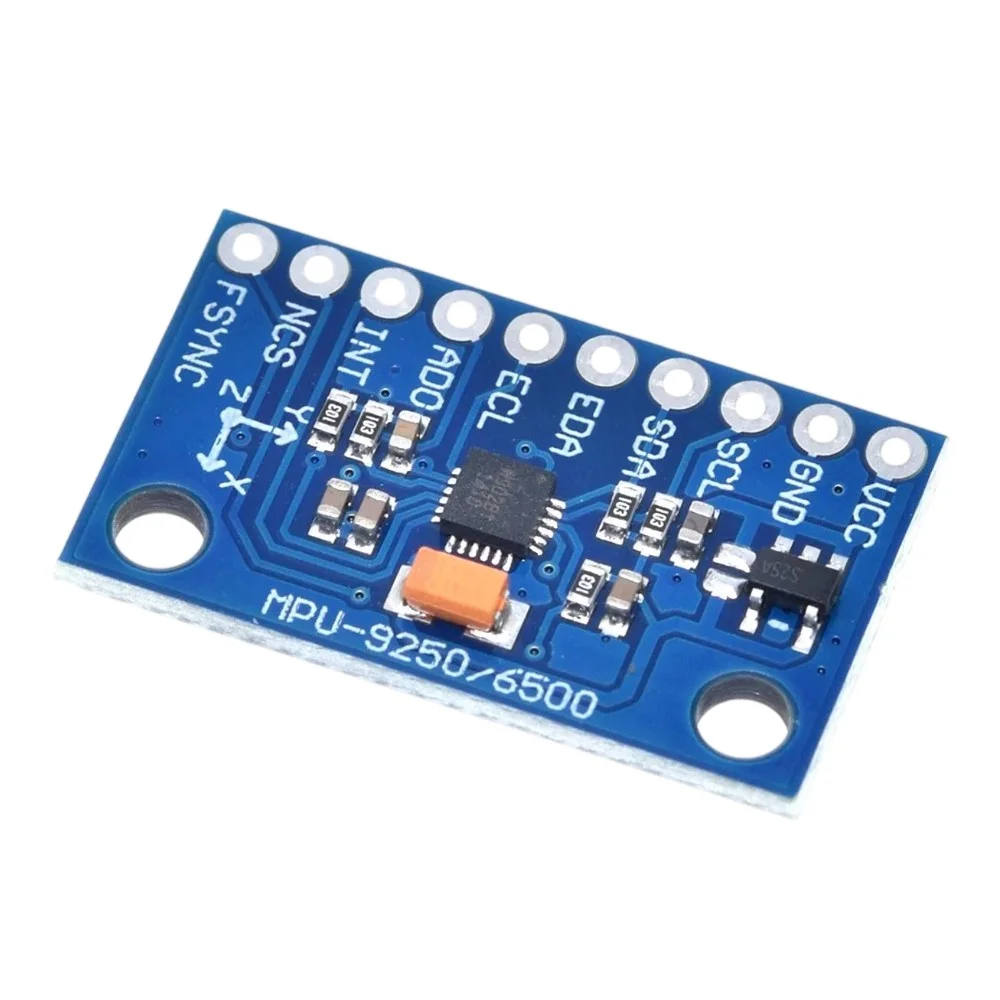
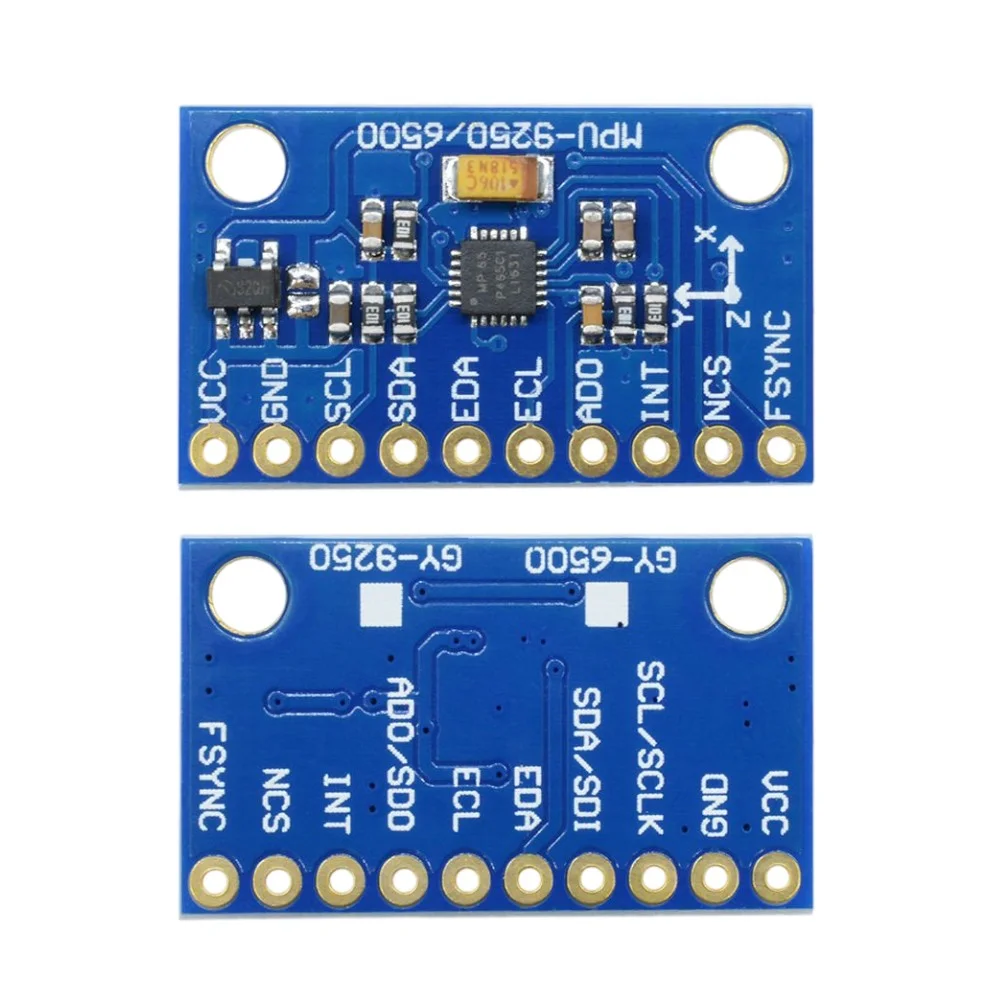
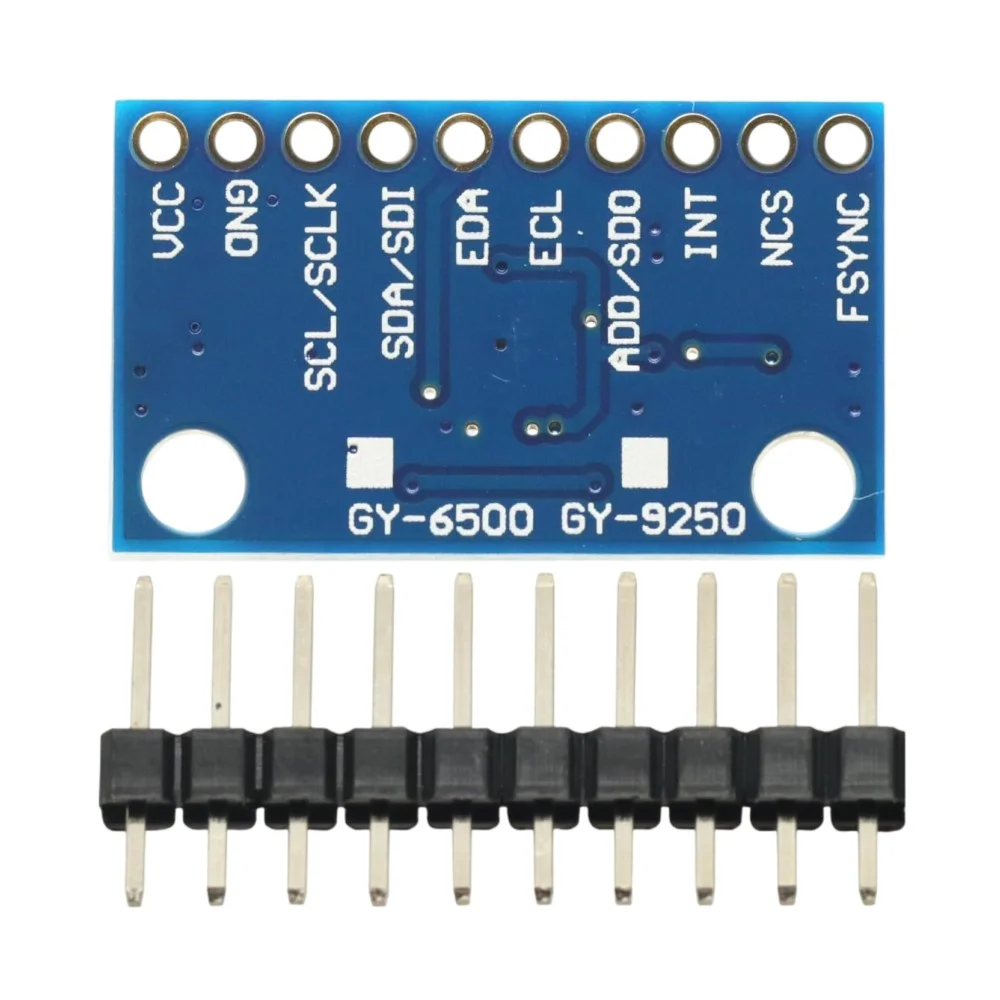

The MPU6500 6-Axis Accelerometer Gyroscope Sensor Module GY-6500 / GY-9250 is a compact Inertial Measurement Unit (IMU) designed for motion, orientation, tilt, acceleration, and rotational movement detection. The module combines a 3-axis accelerometer and 3-axis gyroscope in a single sensor, providing six degrees of motion sensing.
The module is suitable for Arduino, ESP32, Raspberry Pi, robotics, drones, balancing robots, motion-control systems, and other embedded projects requiring real-time motion and orientation data.
The supplied module may be marked GY-6500 or GY-9250 depending on the board version or labeling. The sensor IC identified on this type of module may be marked MP92. For the tested module, the sensor’s WHO_AM_I identification value is 0x70, which corresponds to the MPU6500.
Key Features
- 6-axis Inertial Measurement Unit (IMU)
- Integrated 3-axis accelerometer
- Integrated 3-axis gyroscope
- MPU6500 sensor IC
- Sensor identification value: 0x70
- Compact breakout module
- Digital motion sensing
- Suitable for orientation and tilt detection
- Useful for robotics and balancing applications
- Compatible with popular microcontrollers
- Suitable for I2C-based motion-sensing projects
- Useful for real-time movement and rotation monitoring
Technical Specifications
- Sensor IC: MPU6500
- IC Marking: MP92
- WHO_AM_I / Chip ID: 0x70
- Sensor Type: 6-Axis IMU
- Accelerometer: 3-Axis
- Gyroscope: 3-Axis
- Acceleration Measurement: Configurable range
- Gyroscope Measurement: Configurable range
- Communication: Digital I2C / SPI
- Module Type: Breakout Sensor Module
- Operating Voltage: Suitable according to the module’s onboard circuitry
- Applications: Motion sensing, robotics, stabilization, orientation, and control systems
Working Principle
The MPU6500 integrates a 3-axis MEMS accelerometer and a 3-axis MEMS gyroscope.
The accelerometer measures linear acceleration along the X, Y, and Z axes, allowing the controller to determine changes in movement, tilt, and acceleration.
The gyroscope measures angular velocity around the X, Y, and Z axes, allowing the system to detect rotation and changes in angular movement.
A microcontroller such as an Arduino or ESP32 communicates with the sensor digitally and reads the measured motion data. The accelerometer and gyroscope readings can then be processed to determine orientation, movement, rotation, and stabilization parameters.
Applications
- Self-balancing robots
- Arduino robotics projects
- ESP32 motion-sensing projects
- Drone and UAV projects
- Robot orientation detection
- Tilt detection
- Motion detection
- Gesture and movement sensing
- Camera and platform stabilization
- Gimbal projects
- Inertial navigation experiments
- Flight-control experiments
- IoT motion monitoring
- STEM and educational projects
Advantages
- Combines accelerometer and gyroscope in one sensor
- Provides 6-axis motion information
- Compact and easy to integrate
- Suitable for robotics and embedded systems
- Supports digital communication
- Useful for real-time motion analysis
- Suitable for balancing and stabilization projects
- Can be used with widely available microcontroller platforms
Usage Tips
- Verify the module’s actual sensor identity before programming, especially when the board is labeled GY-9250 or GY-6500.
- For this module, a WHO_AM_I value of 0x70 indicates MPU6500.
- Use the correct MPU6500 library or register configuration in your project.
- Connect the module according to the selected communication interface.
- Keep the sensor firmly mounted when accurate motion measurements are required.
- Avoid excessive vibration when using the module for balancing or orientation applications.
- Perform calibration when accurate accelerometer and gyroscope measurements are required.
- Check the module’s actual supply requirements before connecting it to a power source.
Note:
The module may be labeled GY-6500 or GY-9250 depending on the board version. The tested sensor IC identifies itself with chip ID 0x70, corresponding to MPU6500.
Images are for Illustration Purposes Only.
Which MPU6500 module should I buy for my project?
Buy the MPU6500 module if your project needs 6-axis motion sensing and you can confirm the chip with a WHO_AM_I value of 0x70. This board is listed at Rs. 900, price checked in October 2026, and it is in stock.
Before ordering, match the module to the job:
- Balancing robots and self-balancing platforms: you need both the accelerometer and the gyroscope working together, so a 6-axis IMU like this one fits.
- Tilt and orientation sensing: the 3-axis accelerometer handles tilt and linear acceleration, which is enough for many simple projects.
- Rotation and angular movement: the 3-axis gyroscope covers this, and it is the part most people forget when they pick a sensor.
- Drone and gimbal work: you want fast, stable readings, so mount the board firmly and calibrate it before flight tests.
If your project only needs distance measurement or obstacle detection, a simpler sensor will do the job for less. The HC-SR04 Ultrasonic Distance Sensor Module handles non-contact distance, the IR Infrared Obstacle Avoidance-Line Follower Sensor Module covers line following and obstacle avoidance, and the 5V 1-Channel Arduino Relay Module Board switches loads from your controller. Browse the full Sensors And Modules range if you are building a complete kit.
How do I install and use the MPU6500 module with Arduino or ESP32?
Wire the module to your board over I2C or SPI, confirm the chip ID, then load an MPU6500-compatible library before you read any data.
- Check the label first. The board may be marked GY-6500 or GY-9250, but the tested chip here reports 0x70, which is the MPU6500. Program for MPU6500, not MPU9250.
- Connect power and signal. Use the module’s onboard circuitry to set the correct supply, then connect SDA and SCL for I2C, or the SPI pins if you choose that interface.
- Run a WHO_AM_I check. If the value is 0x70, your wiring and library are talking to the right sensor.
- Calibrate. Keep the board still and level during calibration so the accelerometer and gyroscope offsets are set correctly.
- Mount it firmly. Loose mounting adds vibration noise, which shows up as drift in balancing and orientation projects.
Delivery is nationwide across Pakistan at a flat rate of Rs 350. If you are a student and want help choosing between this module and a simpler sensor, ask us when you order and we will point you to the right part for your project.
Frequently Asked Questions
What is the difference between the GY-6500 and GY-9250 labels on this module?
The board you receive may be marked GY-6500 or GY-9250 depending on the version or labeling. The tested module identifies itself with a WHO_AM_I value of 0x70, which corresponds to the MPU6500 sensor. Always verify the chip ID before programming so your library and register settings match the actual sensor.
Can I use the MPU6500 module with an Arduino, ESP32 or Raspberry Pi?
Yes. The module uses digital I2C or SPI communication, so it works with Arduino, ESP32 and Raspberry Pi boards. Connect it according to the interface you choose, use an MPU6500-compatible library, and check the module’s supply requirements before powering it from your board.
What projects is the MPU6500 6-axis sensor module used for?
It suits self-balancing robots, drones and UAVs, gimbals, camera and platform stabilization, tilt and motion detection, gesture sensing, robot orientation, inertial navigation experiments, flight-control experiments, IoT motion monitoring and STEM projects. Any project that needs real-time acceleration and rotation data can use it.
How much does the MPU6500 module cost and is it in stock?
The MPU6500 6-Axis Accelerometer Gyroscope Sensor Module GY-6500 / GY-9250 is listed at Rs. 900, price checked in October 2026, and it is in stock. Delivery is nationwide across Pakistan at a flat rate of Rs 350.
Do I need to calibrate the MPU6500 before using it?
Calibration is recommended when you need accurate accelerometer and gyroscope readings. Keep the module still and level during calibration, mount it firmly, and avoid excessive vibration in balancing or orientation projects. This reduces drift and gives more stable motion data in your readings.






Reviews
There are no reviews yet