
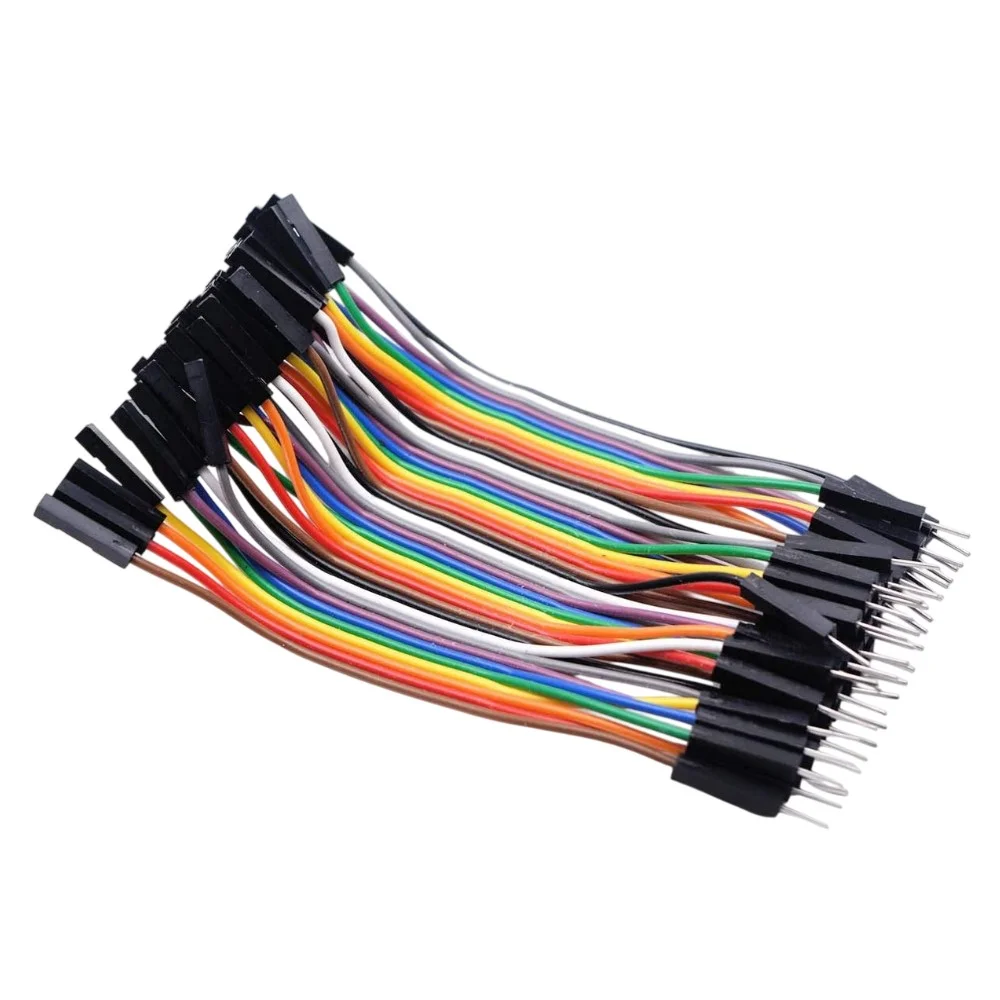

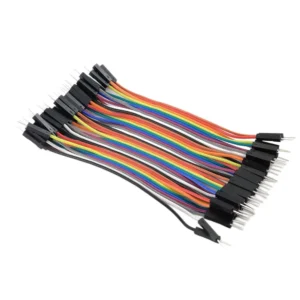
The 10cm Male-to-Female Pin-to-Hole Jumper Wires Set is a convenient collection of pre-terminated jumper wires designed for quick and reliable connections between electronic modules, development boards, sensors, breadboards, and other components.
Each wire features a male pin connector on one end and a female socket connector on the other, making it ideal for connecting male header pins to female header pins or sockets. The wires are available in 20-piece and 40-piece sets, providing a practical solution for electronics prototyping, Arduino projects, robotics, and STEM experiments.
Key Features
- Male-to-female jumper wire configuration
- Approximate length: 10cm per wire
- Available in 20-piece and 40-piece sets
- Pre-terminated connectors for easy installation
- Suitable for breadboards and pin headers
- Flexible and easy to route
- Multiple colors for easy circuit identification
- No soldering required for standard pin-header connections
- Ideal for prototyping and electronics experiments
- Useful for Arduino, ESP32, Raspberry Pi, and robotics projects
Technical Specifications
- Product Type: Jumper Wire Set
- Connector Type: Male-to-Female
- Approximate Length: 10cm
- Available Quantities: 20pcs / 40pcs
- Connection Type: Pin-to-Hole
- Wire Design: Flexible insulated jumper wire
- Termination: Pre-crimped male pin and female socket
- Application: Electronics prototyping and circuit connections
- Compatibility: Standard 2.54mm header pins and compatible breadboard/module connections
Working Principle
These jumper wires provide a simple electrical connection between compatible electronic components. The male pin end can be inserted into a breadboard, female header, or suitable socket, while the female end can be connected to a male header pin on an Arduino board, sensor module, development board, or other electronic component.
The pre-terminated design allows circuits to be assembled and modified quickly without soldering.
Applications
- Arduino projects
- ESP32 development
- Raspberry Pi projects
- Breadboard prototyping
- Sensor module connections
- Electronics experiments
- Robotics projects
- IoT projects
- Microcontroller projects
- STEM and educational projects
- Development board wiring
- Temporary circuit connections
Advantages
- Easy plug-and-play connections
- No soldering required for compatible headers
- Saves time during prototyping
- Flexible and easy to organize
- Male-to-female configuration provides versatile connections
- Multiple colors help identify different connections
- Available in 20pcs and 40pcs sets
- Suitable for beginners and experienced electronics users
Usage Tips
- Ensure the connector type matches the headers on your components.
- Insert the connectors firmly but avoid excessive force.
- Use different wire colors to help identify power, ground, and signal connections.
- Check the circuit connections before applying power.
- Avoid pulling the wire itself when disconnecting; hold the connector housing where possible.
- Keep unused wires organized to prevent tangling and accidental connections.
Note: Images are for Illustration Purposes Only.
Which jumper wire set should I buy, 20pcs or 40pcs?
Choose the 40pcs set if you are wiring several modules at once, and the 20pcs set for a single small build. Both sets use the same 10cm male-to-female wire, so the only difference is the count.
A few things to keep in mind:
- 20pcs suits one Arduino or ESP32 board with a sensor or two.
- 40pcs suits a breadboard project with several sensors, a display and a motor driver.
- Buying the larger set costs little more and saves a second order later.
- Spare wires are handy when one gets bent or lost during a build.
If your project also needs indicator lights, resistors or buttons, you can add 5mm LEDs, metal film resistors and a tactile push button switch from the same Accessories range. The 10cm male-to-female jumper wires set is priced at Rs. 80, checked in October 2026.
How do I connect male-to-female jumper wires?
Push the male pin into a breadboard or female socket, and slide the female end onto a male header pin. No soldering is needed for standard 2.54mm headers.
Follow these steps:
- Check that the header on your board or module is a male pin, since the female end only fits male headers.
- Insert the male pin end into the breadboard row or female socket you need.
- Press the female socket onto the board or sensor pin until it sits fully down.
- Use different colours for power, ground and signal so the circuit is easy to trace.
- Hold the connector housing when unplugging, not the wire.
Before powering up, check each connection again. A loose wire on a power rail can stop a whole project from working.
Frequently Asked Questions
What is a 10cm male-to-female jumper wire used for?
It connects a male header pin to a breadboard, female socket or another female header. The male pin goes into the breadboard or socket, and the female end slides onto a board or module pin. It is used for Arduino, ESP32, Raspberry Pi, sensor and robotics wiring where soldering is not practical.
Do these jumper wires need soldering?
No. Both ends are pre-crimped, so the wires plug straight into standard 2.54mm header pins, breadboards and compatible sockets. You can build and change a circuit in seconds. Soldering is only needed if you want a permanent connection to a bare wire or pad.
Are the wires compatible with Arduino, ESP32 and Raspberry Pi?
Yes. They fit standard 2.54mm male header pins, which covers most Arduino, ESP32 and Raspberry Pi boards and modules. The female end needs a male pin to grip, so check your board headers before ordering. They also work with breadboards and sensor modules.
Do you deliver jumper wires across Pakistan?
Yes. College Road Electronics delivers nationwide across Pakistan at a flat-rate shipping charge of Rs 350. The shop is on College Road, Rawalpindi, and also supports students who need parts and guidance for school, college and university projects.





Jamil Ahmad (verified owner) –
Good quality wires.
Jamil Ahmad –