
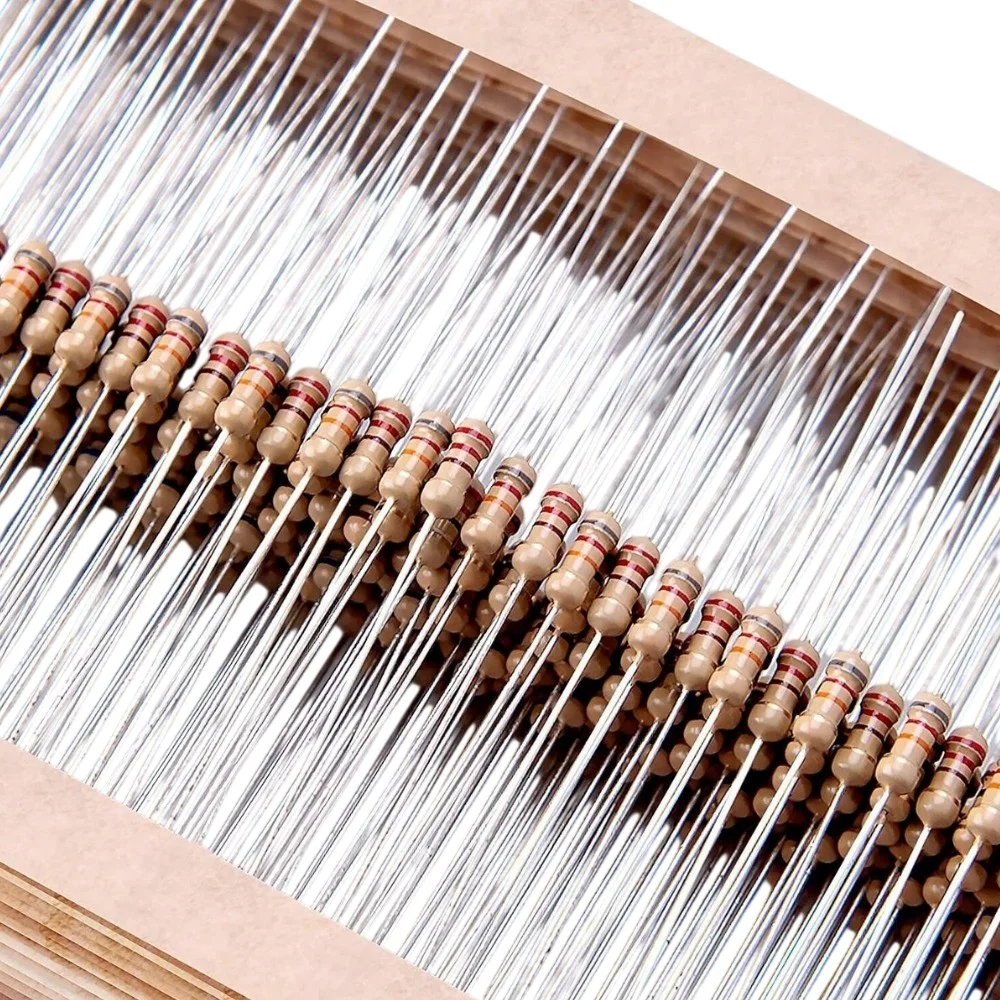

The Metal Film Resistors (1kΩ to 10MΩ) (1/4 Watt) are high-precision fixed resistors designed for a wide range of electronic and electrical applications. Manufactured using a thin metal film deposited on a ceramic substrate, these resistors offer excellent accuracy, low noise, high stability, and superior temperature performance compared to standard carbon film resistors.
Available in resistance values ranging from 1kΩ to 10MΩ, these 0.25W (1/4 Watt) resistors are ideal for current limiting, voltage division, pull-up/pull-down circuits, signal conditioning, timing circuits, and general-purpose electronic designs. They are widely used in Arduino projects, Raspberry Pi applications, robotics, power supplies, amplifiers, communication equipment, and educational electronics.
The through-hole radial lead design makes them easy to install on PCBs, breadboards, and prototype circuits.
Key Features of Metal Film Resistors
- High-Quality Metal Film Resistors
- Resistance Range: 1kΩ to 10MΩ
- Power Rating: 1/4 Watt (0.25W)
- High Precision and Stability
- Low Electrical Noise
- Excellent Temperature Stability
- Through-Hole Radial Lead Design
- Suitable for Breadboards and PCBs
- Long Operational Life
- Ideal for Professional and DIY Electronics
Technical Specifications
- Product Type: Fixed Metal Film Resistor
- Resistance Range: 1kΩ to 10MΩ
- Power Rating: 0.25W (1/4 Watt)
- Resistor Type: Metal Film
- Tolerance: Typically ±1% (may vary by manufacturer)
- Temperature Coefficient: Low (varies by model)
- Mounting Type: Through-Hole
- Lead Type: Axial Leads
- Body Material: Flame-Retardant Epoxy Coating
- Operating Temperature: Typically -55°C to +155°C
- RoHS Compliant: Yes (varies by manufacturer)
How Metal Film Resistors Work
A metal film resistor limits the flow of electrical current by providing a precise resistance value. The thin metal film deposited on a ceramic core determines the resistance, while laser trimming during manufacturing ensures accurate resistance values.
When current passes through the resistor, electrical energy is partially converted into heat, helping regulate voltage, limit current, divide signals, and protect sensitive electronic components.
Applications
- Arduino Projects
- Raspberry Pi Projects
- ESP32 and ESP8266 Circuits
- Voltage Divider Networks
- Current Limiting Circuits
- Pull-Up and Pull-Down Resistors
- Sensor Interface Circuits
- Audio Amplifiers
- Power Supply Circuits
- Educational Electronics
- Robotics and Automation
- DIY Electronics Projects
Advantages
- High accuracy and precision
- Low electrical noise
- Excellent long-term stability
- Better temperature performance than carbon film resistors
- Reliable operation in precision circuits
- Easy PCB and breadboard installation
- Wide resistance value selection
- Suitable for professional and hobby applications
Usage Tips
- Select the correct resistance value according to your circuit requirements.
- Ensure the resistor’s power dissipation does not exceed 0.25W.
- Verify the resistor value using the color code or a multimeter before installation.
- Keep resistor leads as short as practical in high-frequency circuits.
- Avoid excessive heat during soldering to maintain accuracy.
- Store resistors in a dry, moisture-free environment.
Note: Images are for illustration purposes only.
Which metal film resistor value should I choose for my circuit?
Match the value to the job the resistor does in the circuit, not to what looks close on the shelf. A wrong value still works sometimes, but it drifts, heats up or gives the wrong voltage.
- Current limiting for an LED: pick a value that keeps the LED current small. 220Ω to 1kΩ covers most 5V indicator circuits.
- Pull-up or pull-down: 10kΩ is the common choice on Arduino, ESP32 and Raspberry Pi input pins.
- Voltage divider: use two values in a known ratio, for example 10kΩ and 10kΩ for half the supply.
- Base resistor for a transistor: 1kΩ to 10kΩ depending on the transistor and load.
- Timing or filter circuits: the value works with a capacitor, so calculate both together.
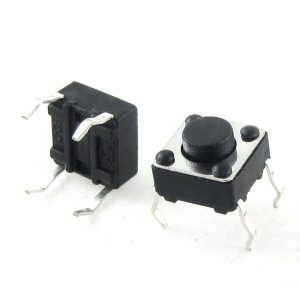
This range covers 1kΩ, 1.2kΩ, 1.5kΩ, 1.8kΩ, 2.2kΩ, 2.7kΩ, 10kΩ, 12kΩ, 15kΩ, 18kΩ, 22kΩ, 27kΩ, 100kΩ, 120kΩ, 150kΩ, 220kΩ, 270kΩ, 1MΩ and 10MΩ. If you are unsure, buy a few values and test. A multimeter confirms the value before you solder. Pair them with 5mm LEDs (Red, Green, Blue, Yellow, White and Red/Blue) and a Tactile Push Button Switch (Big/Small) for practice builds.
How do I install and solder 1/4 Watt metal film resistors?
Bend the axial leads to fit your board, push the body close to the surface, and solder. The 1/4 Watt body is small enough for breadboards and most PCBs.
- Read the color code or measure the resistor with a multimeter first.
- Bend both leads at 90 degrees using your fingers or pliers. Keep the bend outside the body.
- Insert the leads through the holes and seat the body flat against the board.
- Solder each joint quickly, then trim the extra lead length.
- Check the joint with a quick tug and a visual inspection.
Keep soldering time short. Too much heat can shift the value. In high-frequency circuits, keep the leads as short as practical. On a breadboard, use short 20cm Male-to-Female Pin-to-Hole Jumper Wires Set 20pcs/40pcs to reach the rails without long loops. Store spare resistors in a dry box so the leads do not oxidise.
Price, delivery and warranty for metal film resistors
Single metal film resistors are listed at Rs. 2, checked in October 2026. That low unit price makes it practical to order a set of values instead of one or two.
College Road Electronics is based on College Road, Rawalpindi and delivers nationwide across Pakistan at a flat-rate shipping charge of Rs 350. If you are buying a few resistors only, add the other parts for your build to the same order so the shipping cost is shared. Students working on school, college or university projects can ask for guidance on choosing values before ordering. For related parts, see the full Accessories range.
Frequently Asked Questions
What does the 1/4 Watt rating mean on these metal film resistors?
It is the maximum power the resistor can safely dissipate as heat. In most Arduino, ESP32 and Raspberry Pi signal circuits the actual power is far below that, so the rating is comfortable. Keep the calculated power below 0.25W and leave some margin in circuits that run warm or continuously.
Are these metal film resistors suitable for Arduino and Raspberry Pi projects?
Yes. They are through-hole axial parts, so they fit breadboards and PCBs directly. Common uses include LED current limiting, pull-up and pull-down on input pins, voltage dividers for sensors, and base resistors for transistors. The low noise and stable value help sensor and audio circuits read more cleanly.
How do I read the color code on a metal film resistor?
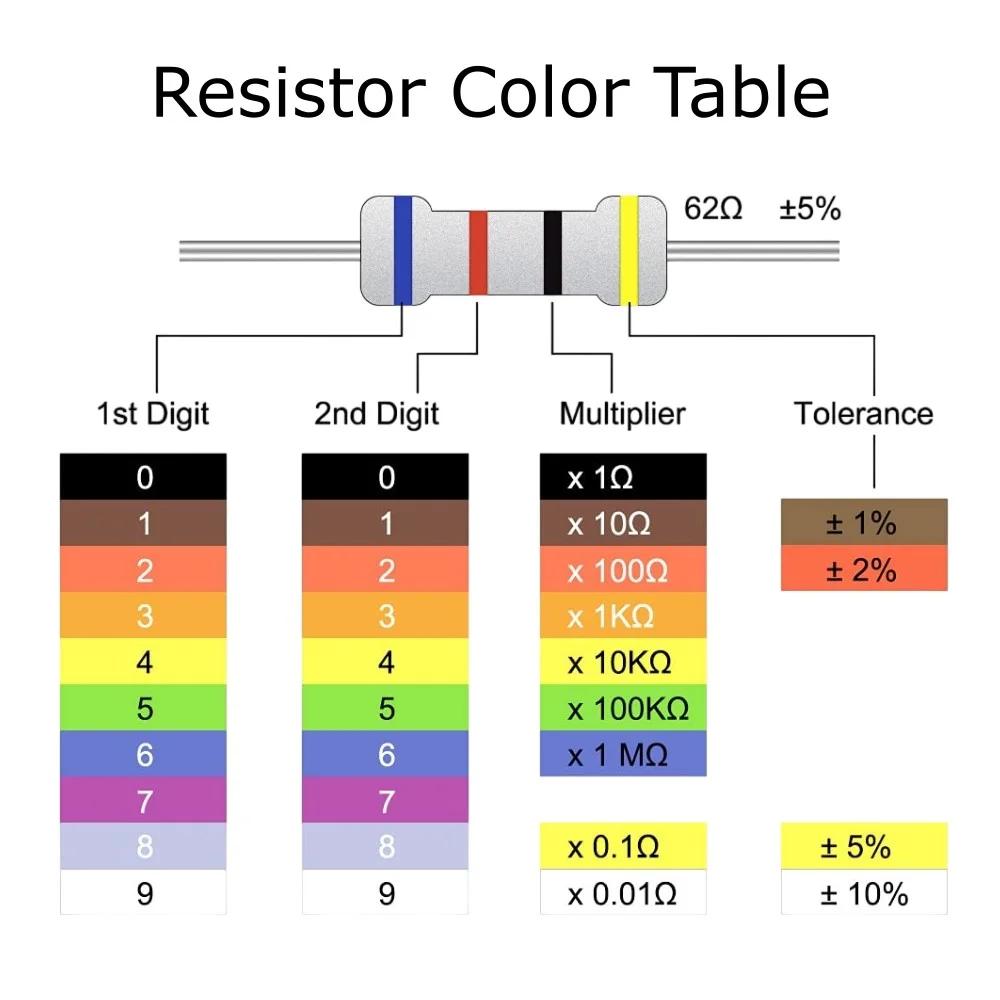
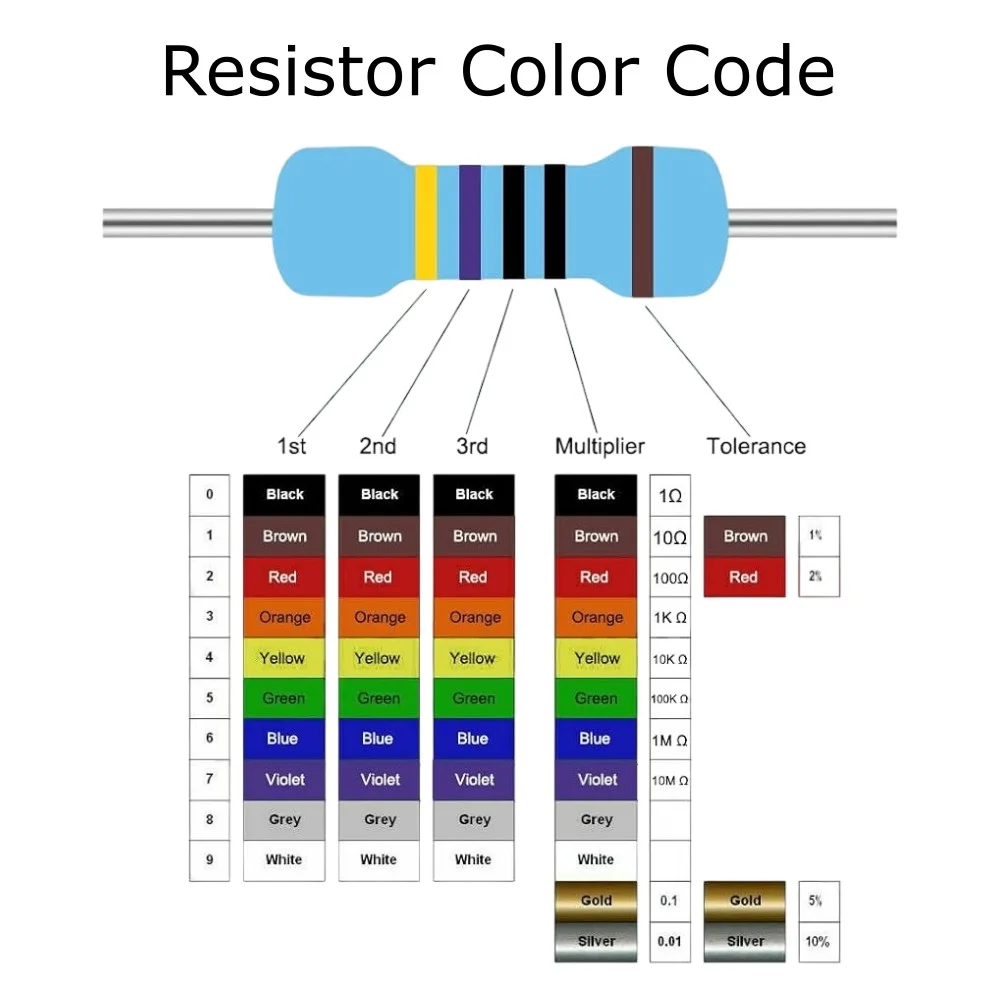
Metal film resistors usually have five bands. The first three give the significant digits, the fourth is the multiplier, and the fifth is the tolerance. Read from the band closest to one end. If the code is hard to see, measure the resistor with a multimeter before soldering it into the circuit.
Can I mix different resistance values in one order?
Yes. The range covers 1kΩ up to 10MΩ, including common values such as 1kΩ, 10kΩ, 100kΩ and 1MΩ. Ordering several values together is useful for students and makers who build more than one circuit, and it keeps a small stock ready for future projects.
Do you deliver metal film resistors across Pakistan?
Yes. College Road Electronics delivers nationwide across Pakistan at a flat-rate shipping charge of Rs 350. The shop is on College Road, Rawalpindi, and supports school, college and university students with parts and guidance for their projects.



Reviews
There are no reviews yet