
The notice comes home from school with about two weeks of warning. Science exhibition on such and such date, every student must submit a working project. What follows is usually a scramble through the market for parts, a model glued together the night before, and something that either does not work on the day or works but the child cannot explain.
It does not have to go that way. The projects below are sorted by class, matched to chapters your child is already studying, and chosen because they keep working for the full three hours of an exhibition. Some you can build at home for almost nothing. Others come as complete kits when you do not have time to hunt for components.
In almost every school exhibition, marks come down to four things. The model works, and keeps working. The student can explain the principle in their own words. The project connects to something in the syllabus. And the display is neat enough to read from a metre away. An expensive project that sits still scores lower than a simple one that runs and gets explained well.
Three rules before you pick a project
- It must survive three hours. Anything relying on ice, a balloon staying inflated, or a chemical reaction that finishes in five minutes will be dead by the time the judges arrive. Choose something you can reset and run again in front of each visitor.
- Your child must build it, not you. Judges ask questions. A child who assembled the thing themselves can answer. A child who watched their father assemble it cannot, and it shows immediately.
- Match it to a chapter. A project tied to a topic from the current class textbook always scores better than an impressive but unrelated build, because the student can connect it to what they have studied.
Science Projects for Class 6
Class 6 covers the solar system, separation of substances, magnets, light and shadows, and simple circuits. At this age the goal is to make something abstract visible. The child is not expected to explain deep theory, only to show a principle clearly and describe what is happening.
1. A solar system model where the planets actually move
Every exhibition has three or four static solar system charts. A model where the planets orbit and rotate stands out immediately, because it demonstrates the difference between rotation and revolution instead of just labelling it. This is one of the easiest projects for a class 6 student to explain confidently, since the motion does the explaining.
2. Growing your own crystals
Crystal growing covers saturation, solution and crystallisation, which sits directly on the class 6 separation of substances chapter. The catch is timing, since crystals take several days to form. Start this one at least a week before the exhibition and photograph each stage, because the photo sequence is what impresses the judges as much as the final crystal.
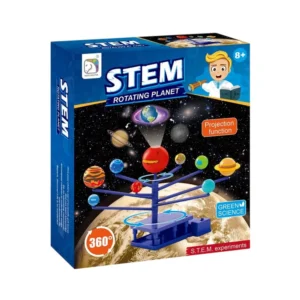
STEM Rotating Planet DIY Learning Kit
A solar system model with real motion, so rotation and revolution are shown rather than described.
- Demonstrates orbit and spin
- No coding or soldering
- Resets instantly between visitors
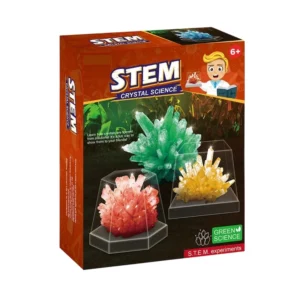
STEM Crystal Science DIY Learning Kit
Grow real crystals from a saturated solution and document the change day by day.
- Covers solutions and crystallisation
- Start seven days before the event
- Produces a keepable result
3. Water filtration model
Cut the base off a 1.5 litre bottle, invert it, and layer cotton, fine sand, coarse sand and gravel inside. Pour muddy water in the top and clean water comes out the bottom. It resets in seconds, it works all day, and the layered structure gives the child something concrete to point at while explaining. Add a labelled diagram of each layer on the display board.
4. Sundial and shadow clock
A stick fixed upright on a marked base, with shadow positions recorded hourly over one day. Works well as a table display with a torch standing in for the sun, so it can be demonstrated indoors. The strength of this project is the data, so bring the recorded readings, not just the model.
Science Projects for Class 7
Class 7 introduces weather and climate, heat, acids and bases, winds and storms, and motion and time. This is the year where measurement starts to matter, so projects that produce a reading score better than projects that only demonstrate.
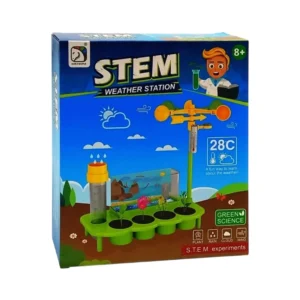
5. A working weather station
This is one of the strongest class 7 projects available, because it does exactly what the weather and climate chapter describes. Instead of writing that meteorologists measure wind speed and direction, the student measures them and records the readings. If you take one project from this list for class 7, take this one, and bring a week of recorded data on the display board alongside the model.
6. Convection current in water
A clear glass container of room temperature water, with a drop of food colouring released near a gently warmed corner. The colour rises, spreads and falls, tracing the convection loop that the textbook draws as arrows. Repeatable in front of every visitor, and it explains sea breeze and land breeze at the same time.
7. Red cabbage acid and base indicator
Boiled red cabbage water turns pink in lemon juice, green in baking soda solution and stays purple in neutral water. Line up six household samples in glasses and let visitors guess before you add the indicator. It is the most interactive project on this list, which matters because judges remember the stall they participated at.
8. Tornado in a bottle
Two bottles joined neck to neck with water in the upper one. A swirl of the wrist creates a visible vortex as the water drains. Pair it with a short explanation of low pressure at the centre of a cyclone and it stops being a toy and becomes a demonstration.
Science Projects for Class 8
Class 8 moves into force and pressure, friction, chemical effects of electric current, natural phenomena and the solar system in more depth. Judges expect more explanation at this level, so pick something with a principle the student can actually unpack rather than just a model that moves.
9. Magnetism and electromagnetism demonstration station
Magnetism is a topic students can describe but rarely show. A multi experiment magnet set lets one project cover attraction and repulsion, magnetic fields, compass behaviour and simple electromagnetic effects at a single table. Because it is several experiments rather than one, the student can adjust what they demonstrate depending on how much time each visitor has, which is a real advantage on a busy exhibition day.
10. Constellations and star projection
The class 8 stars and solar system chapter is almost always presented as a poster. A planetarium projector turns it into something nobody else at the exhibition has, and it gives the student a natural way to explain constellations, why star positions shift through the year, and the difference between a star and a planet. Set it up in the darkest corner of the hall you can negotiate.
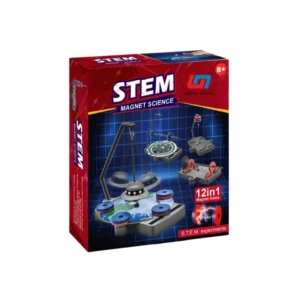
STEM Magnet Science 12 in 1 Kit
Twelve magnetism experiments in one box, so a single stall can show several principles.
- Attraction, repulsion and fields
- Adaptable to short or long visits
- Nothing to consume or replace
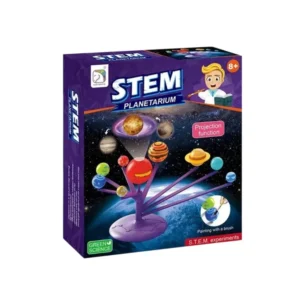
STEM Planetarium DIY Learning Kit
Projects constellations onto a wall or ceiling and turns an astronomy poster into an experience.
- Covers stars and the solar system
- Needs a shaded or dim corner
- Rarely seen at school exhibitions
11. Electrolysis of water
Two pencil leads as electrodes, a 9V battery and slightly salted water. Bubbles form at both electrodes, and collecting them in inverted test tubes shows roughly twice as much gas at one side as the other. That two to one ratio is the whole point of the project, and it is what a good student explains when asked why it matters.
12. Hydraulic lift using syringes
Two water filled syringes joined by a length of tube, mounted on cardboard so pressing one raises a small platform on the other. Use syringes of different sizes and the project becomes a demonstration of force multiplication rather than just movement, which is a noticeably stronger answer when a judge asks how it works.
Kit or build from scratch?
Both routes are valid. The right choice depends mostly on how much time is left and whether the components are available locally.
| Consideration | Build from household items | Complete kit |
|---|---|---|
| Time needed | Longer, since parts must be sourced and tested | Short, everything is in the box |
| Cost | Lowest | Higher, but nothing extra to buy |
| Risk of failing on the day | Higher, improvised joints and fittings give way | Lower, parts are designed to fit |
| Learning value | Excellent if the child solves the problems themselves | Excellent if the child assembles it themselves |
| Best for | Chemistry, pressure and observation projects | Mechanical, optical and magnetic projects |
A practical middle path works well: use a kit for the working model so it is reliable, and build the display board, data tables and diagrams from scratch. The presentation is where most of the marks are decided anyway, and it is the part a student can genuinely own.
If you would rather browse by project type than by class, our guide to the top 10 DIY science project kits for school exhibitions in Pakistan covers solar cars, generators and mechanical models in more detail.
Presenting on the day
- Bring a spare of anything that can break, especially batteries, tape and glue.
- Test the project in the actual hall before judging starts, since lighting and table height change things.
- Write the aim, method and conclusion on the board in three short blocks, not paragraphs.
- Rehearse a thirty second explanation and a two minute explanation, then choose based on how interested the visitor looks.
- Keep a small notebook of readings or observations on the table. Judges pick these up.
- Have the student answer every question, even if a parent knows the answer better.
One thing to avoid: projects that need an open flame, strong chemicals or mains electricity. Many schools disallow them outright, and a project that gets turned away at the gate scores zero regardless of how good it is.
What comes after class 8
Once a student is comfortable assembling models and understands how a basic circuit behaves, the natural next step is sensors. That is the point where a project stops doing the same thing every time and starts reacting to its surroundings, which is the beginning of real automation and robotics. Our Intermediate Electronics Kits cover line tracking cars, obstacle avoiding robots and sensor based builds suited to class 9 and above.
For younger students and for everything covered in this article, the full range sits in Beginner STEM Kits, where no coding or soldering is required and every component is included in the box.
Frequently asked questions
Which science project is best for class 8?
For class 8 the strongest options are projects with a principle the student can explain in depth, such as a magnetism experiment set, an electrolysis demonstration or a hydraulic lift built from syringes. Judges at this level ask follow up questions, so choose a project you can discuss rather than one that only looks impressive.
How long before the exhibition should we start?
Allow at least one week for most projects, and closer to two if you are ordering parts or growing crystals. The build itself is usually the quick part. Testing, fixing what fails and preparing the display board take longer than parents expect.
Do these projects need any coding or programming?
No. Every project in this article works through mechanics, chemistry, optics or simple circuits, with no microcontroller and no software. Coding becomes relevant from around class 9, when students move to Arduino and sensor based builds.
Is a bought kit acceptable for a school science exhibition?
In almost all schools, yes, provided the student assembles it and can explain how it works. Schools object to projects that were clearly built by someone else, not to projects that came in a box. Assembling a kit and documenting the process is treated as legitimate work.
What is a good low cost project if the budget is tight?
The water filtration model, the red cabbage indicator and the convection current demonstration can all be built for very little using household items. All three work reliably for hours and each one connects directly to a chapter in the syllabus.
Can the same project be used for both class 7 and class 8?
Often yes, but the explanation has to change. A class 7 student can describe what a weather station measures, while a class 8 student is expected to explain why pressure differences cause wind. Choose the project by reliability, then pitch the explanation at the right level.
Everything in one box, before the deadline
Complete science project kits with all components included, no soldering and no coding required. Delivery across Pakistan, and you are welcome to visit our shop on College Road, Rawalpindi to see the kits in person.
Browse Beginner STEM Kits