
You have decided to learn Arduino, or your teacher has given you a project deadline. Now you are scrolling through listings and the prices jump from a few thousand rupees to almost double that, with photos that look nearly identical.
This guide settles what actually drives the Arduino starter kit price in Pakistan, what should be inside a kit at each budget level, and how to check a kit before you pay.
What is the typical arduino starter kit price in pakistan?
A basic Arduino starter kit in Pakistan costs around Rs. 3,400 and up, while fuller kits with more sensors and motors run from about Rs. 4,750 to Rs. 6,900. The arduino starter kit price in pakistan depends mainly on the board type, number of sensors, motors, display modules and whether the parts are imported or locally packed.
What is included in a standard Arduino starter kit?
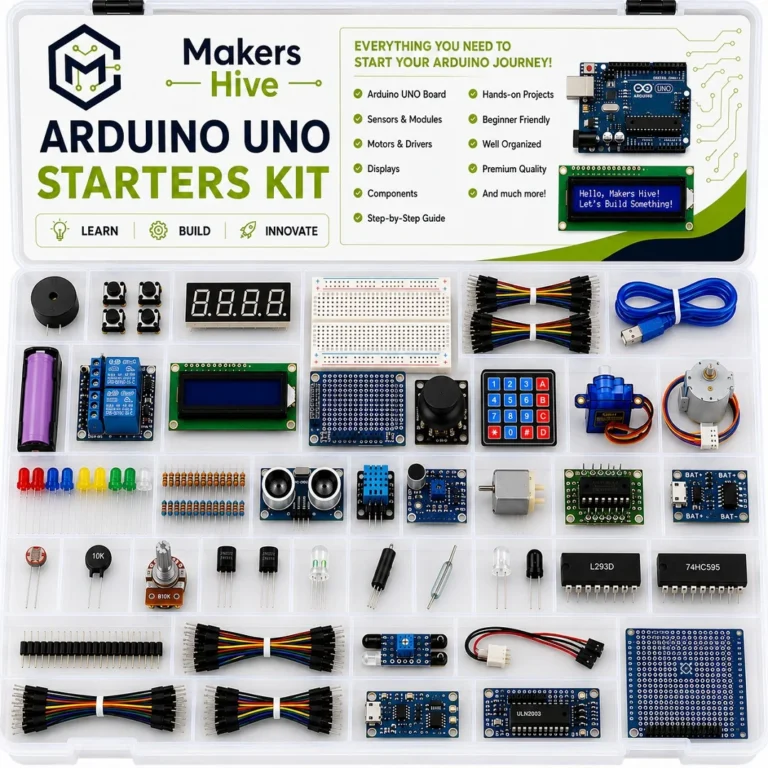
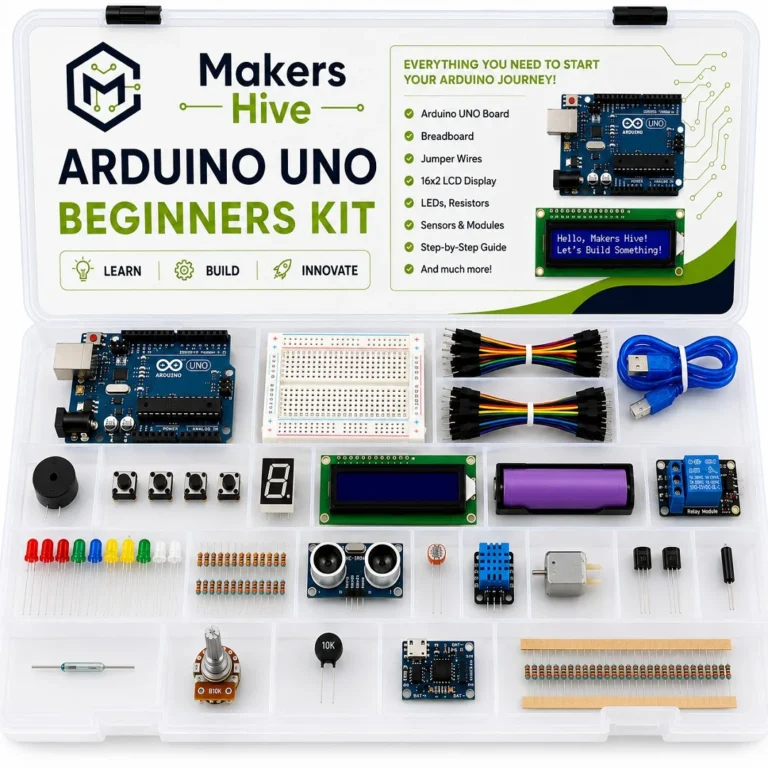
A standard starter kit includes an Arduino UNO board, a breadboard, jumper wires, a USB cable, LEDs, resistors, push buttons and a handful of sensors, all packed in a component box.
At the entry level, expect the basics that get you through blinking LEDs, reading a button and measuring temperature. A typical beginner kit in this range carries an Arduino UNO R3 board, a breadboard, jumper wires, a USB cable, a power supply, and sensors for temperature, light, motion and distance, plus buzzers, relays, motors and a 16×2 LCD.
Step up a level and the kit adds more actuators and modules: servos, stepper motors, an ultrasonic sensor, a DHT11 temperature and humidity sensor, relays and a larger component box. The most complete kits also include colour-coded project guides and example code.
What separates a good kit from a thin one is not the board. It is the count and quality of the small parts: sensors, drivers, displays and motors. Those are the parts you would otherwise buy one by one, and they are where most of the price sits.
Why do Arduino starter kit prices vary so much in Pakistan?
Prices vary because kits are not the same product. Two boxes with the same board inside can differ by thousands of rupees depending on sensors, motors, displays and whether the parts are imported.
The main price drivers are:
- Board type. An UNO R3 or UNO SMD board is the standard. Boards with more pins or wireless built in cost more.
- Sensor count. A kit with four sensors and one with fifteen are different products, even if the box looks similar.
- Motors and drivers. Servos, stepper motors and motor driver modules add real cost.
- Display modules. An LCD or OLED module is a meaningful part of the total.
- Imported vs locally packed. Imported kits usually cost more than locally assembled ones with similar contents.
- Guides and manuals. Printed, colour-coded project guides add value and cost.
Exchange rates and import duties also move prices over the year, which is why a kit quoted in an old video or forum post rarely matches what you see today.
Original vs clone boards: how much should you pay?
Most affordable kits in Pakistan use UNO-compatible boards built around the ATmega328P chip rather than official Arduino-branded boards. They work with the Arduino IDE and standard tutorials, and they keep the kit price reasonable.
What matters for a student is that the board is clearly described, the chip is the ATmega328P, and the USB interface works reliably with your laptop. A board that will not upload code is useless no matter whose name is on it.
Do not pay a premium for a brand name alone. Pay for a board that is described honestly, plus a good set of sensors and a real component box. If a listing hides the board type or shows a stock photo with no part list, treat that as a warning.
For a deeper background on the board itself, see our guide on what is Arduino.
Which kit is right for a school student vs a university student?
School students need a simple kit with clear guides and safe low-voltage parts. University students need more sensors, motors and expansion room for a final-year project.
For class 9, 10 or O Level, a beginner kit is enough. The projects are usually LED patterns, a temperature display, a buzzer alarm or a small line follower. The Arduino Beginner Kit With Component Box at Rs. 3,400 covers this ground with an UNO R3 board, breadboard, sensors, a relay, motors and a 16×2 LCD.
For FSc, diploma and early university work, a mid-range kit gives more headroom. The Arduino Starter Kit with Component Box at Rs. 4,750 adds an UNO SMD board, sensors, motors and display modules in an organised box, which suits lab work and repeated projects.
For a final-year project or a robotics elective, go bigger. The Arduino Upgraded Learning Kit With Component Box at Rs. 6,400 includes an LCD, servo, stepper, relays, ultrasonic and DHT11 sensors, and the imported version at Rs. 6,900 adds colour-coded guides and a 39-part component box.
What parts are usually missing from cheap kits?

Cheap kits often skip the parts that make projects interesting: motor drivers, servos, displays and quality sensors. They also skimp on jumper wires and the component box.
Common gaps to check for:
- No motor driver. A DC motor without an L298N or shield cannot be controlled safely from the board.
- No display. An LCD or OLED is often the first thing cut.
- Few sensors. One or two sensors instead of a real spread of temperature, light, motion and distance.
- Short jumper wire count. You run out mid-project and have to buy more.
- No component box. Loose parts in a bag get lost fast.
- No power option. No battery holder or adapter means the project is tied to your laptop.
A kit that lists its parts clearly and shows the component box is usually the safer buy, even if it costs a little more.
How do you check a kit before buying online?
Check the part list, the board type and the photos before you pay. A listing that shows the actual box and names each sensor is far more trustworthy than one with a generic image.
- Read the full part list and count the sensors and motors.
- Confirm the board: UNO R3, UNO SMD or another model.
- Look for a motor driver, a display module and a breadboard.
- Check whether a USB cable, power supply or battery holder is included.
- See if guides or example code come with it.
- Buy from a shop that gives project guidance, not just a box.
College Road Electronics is based on College Road, Rawalpindi and delivers across Pakistan at a flat Rs. 350 shipping rate, so you can order from anywhere and still ask for help with your project.
Which starter kit should a beginner in Pakistan buy first?
Start with the kit that matches your first three projects, not the biggest box on the page. A beginner who finishes small projects learns more than one who owns parts they never use.
If you are completely new, the beginner kit at Rs. 3,400 is the lowest-risk entry. If you already know you will build sensors and motors, the Rs. 4,750 starter kit is the better value because it includes more modules and a proper component box. If your project is a robot car, skip the general kit and buy a car kit directly.
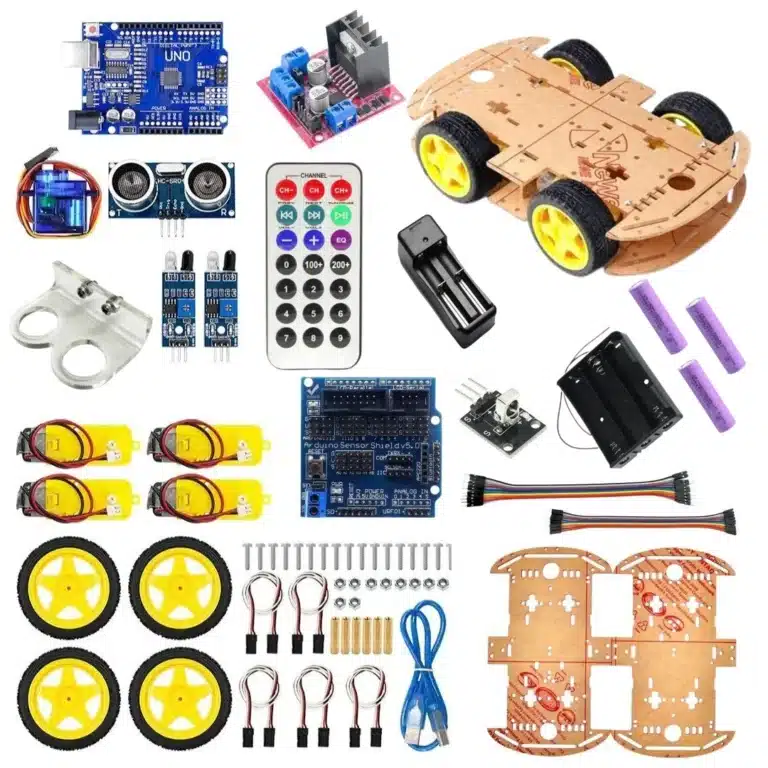
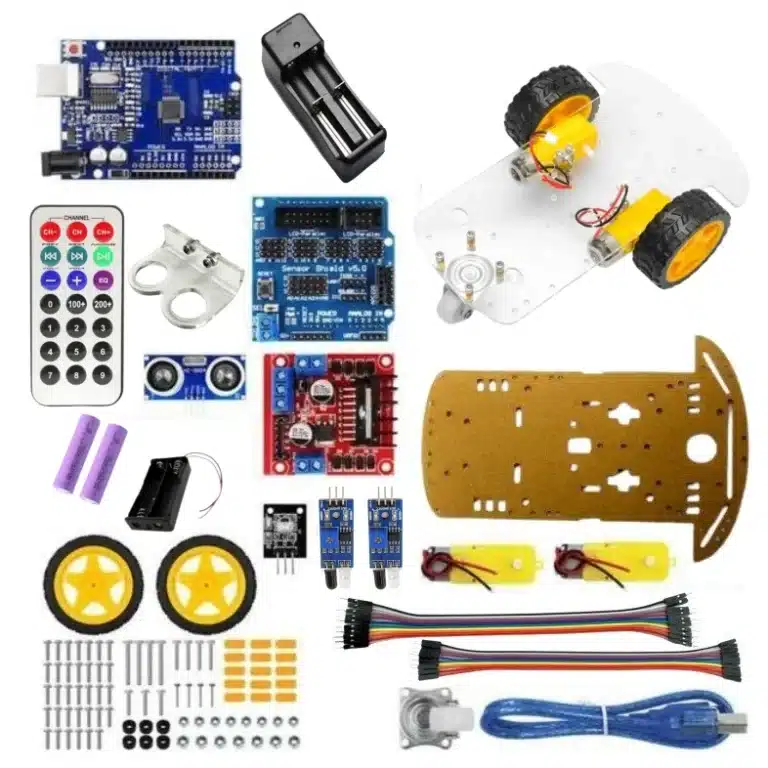
For robotics, the 2WD Arduino Smart Robot Car Kit (Unassembled) at Rs. 4,500 and the 4WD Arduino Smart Robotic Car Kit (UnAssembled) at Rs. 6,500 include chassis, motors, drivers, sensors and batteries, so you build a working robot rather than a pile of parts. The 2WD Arduino Line Following Robot LFR (Unassembled) at Rs. 3,600 is a focused, budget-friendly option for a line follower competition.
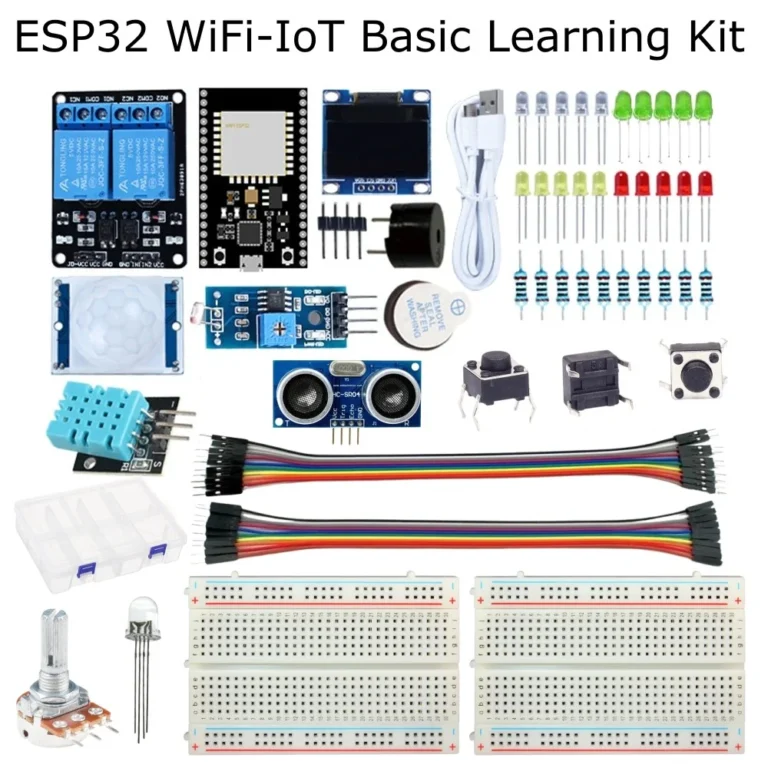
If your interest is IoT and wireless projects, the ESP32 IoT Based Basic Learning Kit with Component Box at Rs. 4,300 gives you Wi-Fi and Bluetooth on the board plus sensors, an OLED and a relay.
Browse the full Intermediate Electronics Kits range to compare all of these side by side.
Which one should you pick?
Pick by project, not by price alone. The cheapest kit that covers your next two projects is the right one.
| Your situation | Recommended kit | Price |
|---|---|---|
| First time, school project | Arduino Beginner Kit With Component Box | Rs. 3,400 |
| College or lab work, more sensors | Arduino Starter Kit with Component Box | Rs. 4,750 |
| University project, full sensor set | Arduino Upgraded Learning Kit With Component Box | Rs. 6,400 |
| Guided learning, imported parts | Arduino Upgraded Learning Kit (Imported) | Rs. 6,900 |
| Robot car project | 2WD or 4WD Arduino Smart Robot Car Kit | Rs. 4,500 – Rs. 6,500 |
| IoT and wireless | ESP32 IoT Based Basic Learning Kit | Rs. 4,300 |
If you are still deciding between robot kits, our Arduino car kit buying guide compares them in detail, and the Arduino robot projects guide shows what students build with each.
Products in this guide
 Arduino Starter Kit with Component Box
 Arduino Upgraded Learning Kit With Component Box
- 4WD Arduino Smart Robotic Car Kit (UnAssembled)
- 2WD Arduino Smart Robot Car Kit (Unassembled)
- Arduino Beginner Kit With Component Box
- Arduino Upgraded Learning Kit With Component Box (Imported)
- ESP32 IoT Based Basic Learning Kit with Component Box
- 2WD Arduino Line Following Robot LFR (Unassembled)


Frequently asked questions
Is an Arduino starter kit worth buying in Pakistan?
Yes, if you plan to build at least a few projects. Buying the board, breadboard, sensors and motors separately costs more and takes several orders. A kit gives you everything in one box with a component tray, so you can start the same day. Choose a kit that lists its parts clearly and matches your project level.
What is the difference between a beginner kit and an upgraded learning kit?
A beginner kit covers LEDs, buttons, basic sensors and simple displays. An upgraded kit adds servos, stepper motors, relays, an ultrasonic sensor, a DHT11 sensor and a larger component box, plus guides in the imported version. The upgraded kit suits students who already know the basics and need more modules for a bigger project.
Do these kits work with the Arduino IDE on Windows and Mac?
Yes. The UNO R3 and UNO SMD boards in these kits use the ATmega328P chip and work with the standard Arduino IDE on Windows, Mac and Linux. Install the IDE, plug in the USB cable, select the board and port, and upload. Most kits also include example code you can test straight away.
Can I use a starter kit for a university final-year project?
A general starter kit is a good base, but check your project needs first. If it involves motors, add a motor driver. If it involves wireless, consider an ESP32 kit instead. Many students combine a starter kit with one or two extra modules rather than buying the largest kit available.
How long does delivery take across Pakistan?
College Road Electronics delivers nationwide across Pakistan at a flat Rs. 350 shipping rate. Delivery time depends on your city and courier, so confirm the current estimate when you order. If you are in Rawalpindi or Islamabad, visiting the shop on College Road is the fastest way to check parts in person.
Are the sensors in these kits safe for school students?
Yes. The kits use low-voltage components that run from USB or a small battery pack, which is safe for classroom and home use. Standard care still applies: do not short the power pins, keep liquids away from the board, and unplug before rewiring a circuit.
