
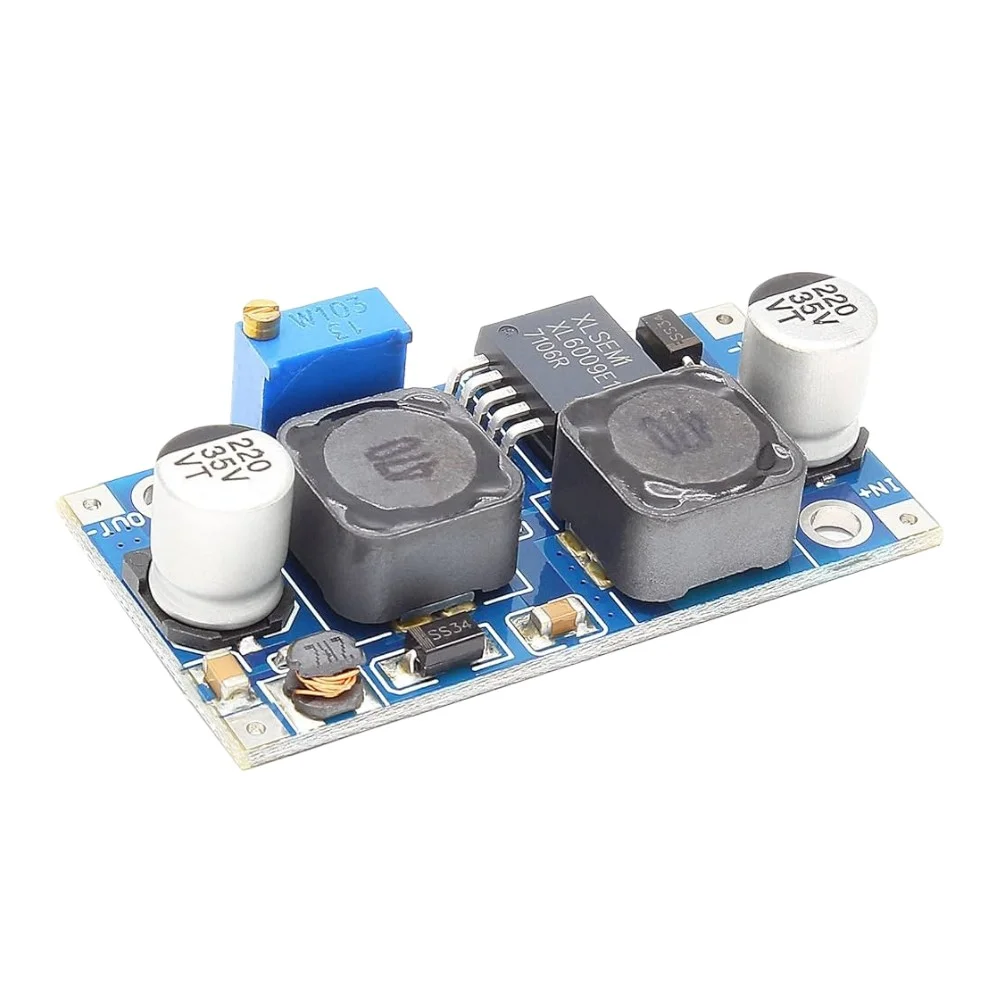
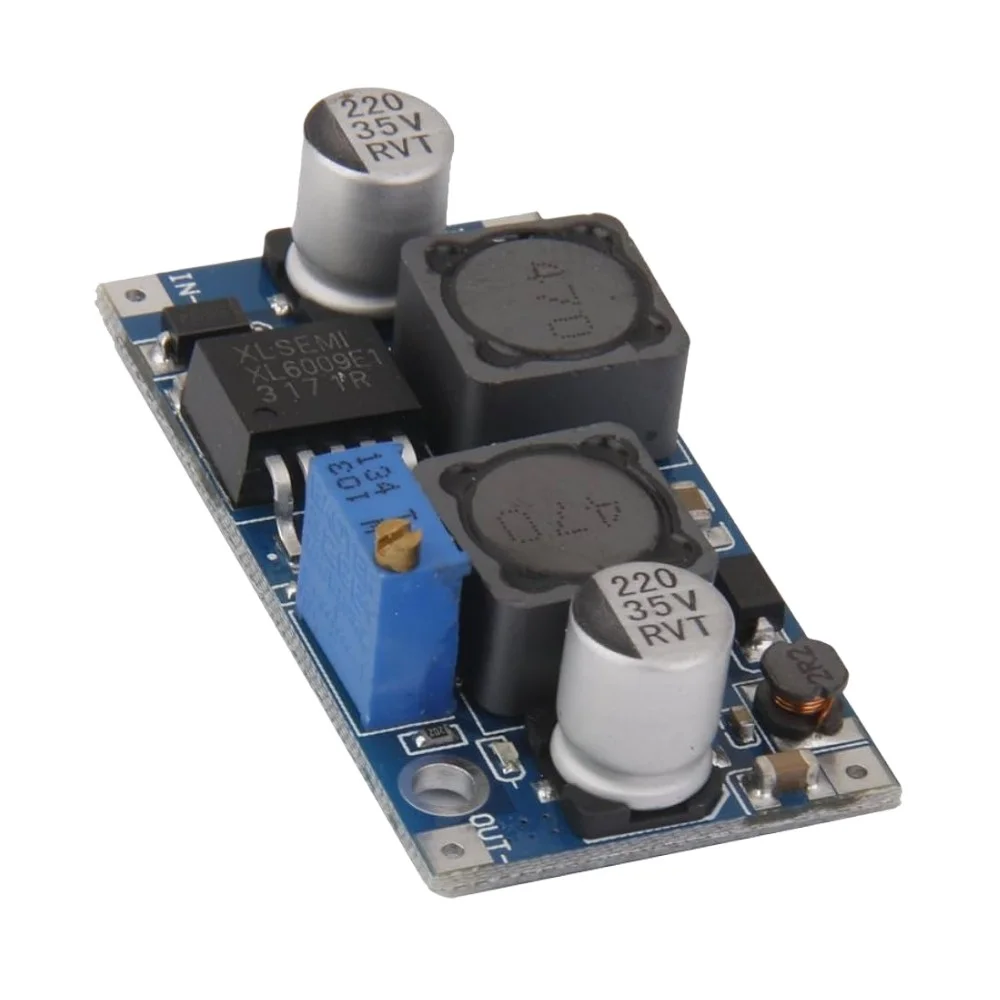

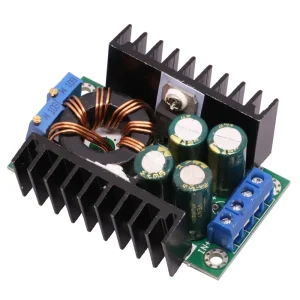
XL6009E1 DC-DC Auto Step Up/Down Buck/Boost Converter Module
The XL6009E1 Buck-Boost Converter Module is a versatile and high-efficiency DC-DC power module capable of both stepping up (boost) and stepping down (buck) voltage automatically. It is widely used in electronics projects where the input voltage fluctuates but a stable adjustable output voltage is required.
Built around the XL6009E1 high-frequency switching regulator, this module ensures efficient power conversion, making it ideal for battery-powered systems, solar applications, and embedded electronics.
Key Features of XL6009E1 Buck-Boost Converter
- Auto Buck-Boost Functionality: Can both increase or decrease voltage automatically
- Wide Input Range: Supports 5V to 32V DC input
- Adjustable Output Voltage: 1.3V to 35V DC via precision potentiometer
- High Output Current: Up to 3A (2A recommended for continuous use)
- High Efficiency: Up to 94% conversion efficiency
- High Switching Frequency: 400kHz for compact design and stable output
- Stable Output Regulation: Maintains constant voltage despite input fluctuations
- Compact and Lightweight: Easy to integrate into portable designs
Technical Specifications
- IC Chip: XL6009E1
- Input Voltage: 5V – 32V DC
- Output Voltage: 1.3V – 35V DC (adjustable)
- Output Current: 0 – 3A (2A recommended without cooling)
- Efficiency: Up to 94%
- Switching Frequency: 400kHz
- Output Ripple: ~50mV
- Operating Temperature: -40°C to +85°C
- Dimensions: Approx. 48 x 25 x 15 mm
How the Buck-Boost Converter Works
This module uses a buck-boost topology:
- If input voltage > set output, acts as buck (step-down)
- If input voltage < set output, acts as boost (step-up)
This automatic switching ensures a constant output voltage, even when the input source (like batteries or solar panels) varies.
Pin and Terminal Details
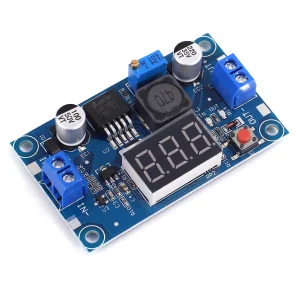
- IN+ / IN-: Connect input power source (5V-32V)
- OUT+ / OUT-: Regulated output (1.3V-35V adjustable)
- Potentiometer: Adjust output voltage (multi-turn for precision)
Applications of XL6009E1 Converter Module
- Battery-powered devices (Li-ion, lead-acid systems)
- Solar power regulation systems
- DIY adjustable power supplies
- Arduino / ESP32 / Raspberry Pi projects
- LED drivers and motor voltage control
- Automotive voltage stabilization
Advantages of Auto Buck-Boost Design
- Handles both step-up and step-down in one module
- Stable output for fluctuating input sources
- Higher efficiency compared to linear regulators
- Compact and cost-effective
Usage Tips and Recommendations
- Always adjust output voltage before connecting load
- Use a heat sink or cooling for currents above 2A
- Ensure input current capability matches load demand
- Avoid reverse polarity to prevent damage
Note: Images are for Illustration Purposes Only.




Reviews
There are no reviews yet