
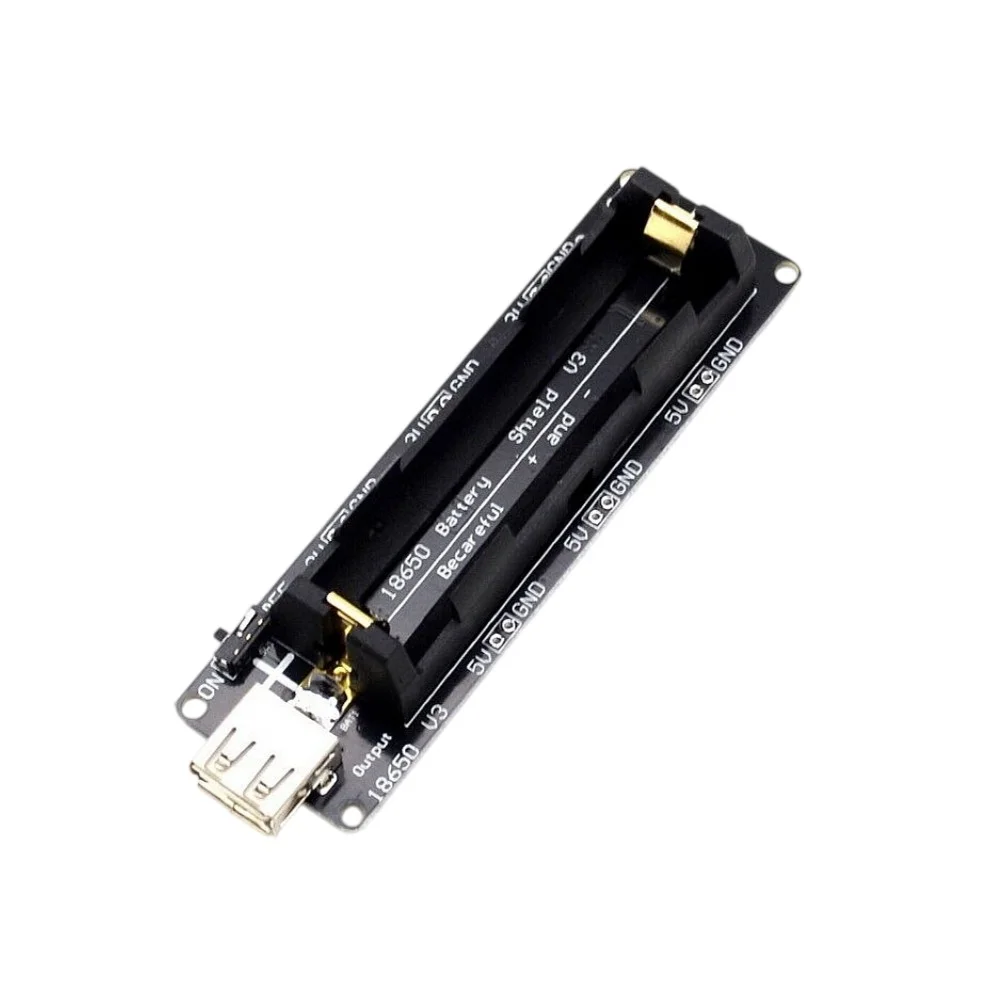
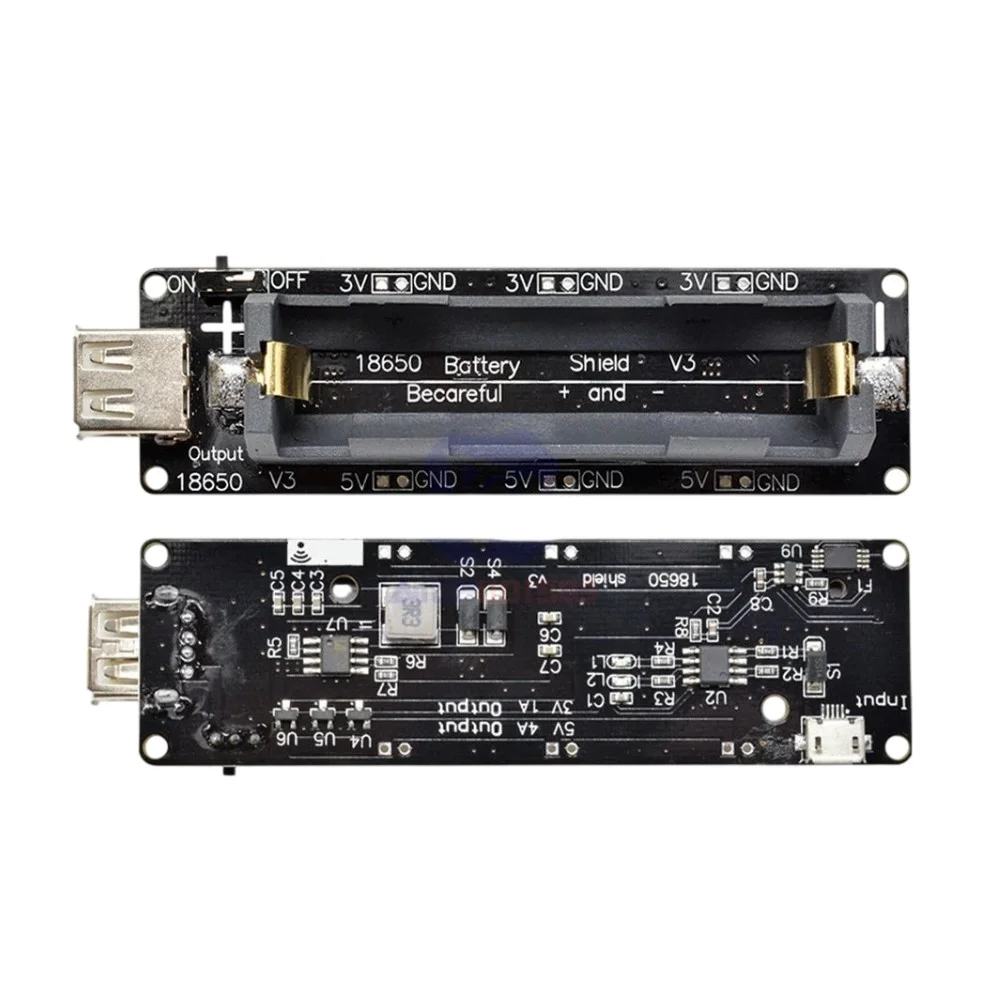

The Lithium Ion 18650 1-Cell Battery Holder Shield V3 is a compact battery holder and charging/power management module designed for a single 3.7V 18650 rechargeable lithium-ion battery cell. It provides a convenient way to securely mount an 18650 battery while allowing the cell to be charged through its built-in Micro-USB charging port.
The V3 shield is suitable for DIY electronics, Arduino projects, ESP32 projects, portable power systems, robotics, IoT devices, and battery-powered prototypes. Its compact PCB design makes it easy to integrate into custom projects where a rechargeable 18650 battery is required.
This version features a simple Micro-USB connector for charging and does not include charging indicator LEDs, making it different from versions that use USB Type-C connectors or provide dedicated charging-status indicators.
Key Features
- Designed for 1 × 18650 Lithium-Ion Battery
- Single-Cell (1S) Battery Configuration
- Nominal Battery Voltage: 3.7V
- Built-In Battery Charging Circuit
- Micro-USB Charging Port
- Compact V3 PCB Design
- Secure 18650 Battery Holder
- Convenient Rechargeable Battery Solution
- Suitable for DIY and Portable Electronics
- Easy to Integrate into Arduino and IoT Projects
- No Charging Indicator LEDs
Technical Specifications
- Product Type: 18650 Battery Holder / Charging Shield
- Model: V3
- Battery Type: 18650 Li-Ion Rechargeable Cell
- Battery Quantity: 1 Cell
- Battery Configuration: 1S
- Nominal Battery Voltage: 3.7V
- Fully Charged Battery Voltage: 4.2V
- Charging Input: 5V DC
- Charging Connector: Micro-USB
- USB Type-C: No
- Charging Indicator LED: Not Included
- Battery Holder: Spring-Contact 18650 Holder
- Mounting Type: PCB Module
- Battery: Not Included
Working Principle
The shield holds a single 18650 lithium-ion battery and provides a convenient charging interface through the Micro-USB port.
When a suitable 5V USB power source is connected to the Micro-USB input, the onboard charging circuit regulates the charging process and charges the connected 18650 cell to its appropriate full-charge voltage.
When the USB power source is disconnected, the stored energy in the 18650 battery can be used to power a connected electronic circuit through the shield’s output connections.
The module is therefore useful for creating rechargeable portable projects without requiring a separate battery holder and charging circuit.
Applications
- Arduino Portable Projects
- ESP32 Projects
- IoT Devices
- Raspberry Pi Pico Projects
- DIY Power Banks
- Portable Electronics
- Robotics Projects
- Battery-Powered Sensors
- LED Lighting Projects
- Rechargeable Electronics Projects
- Embedded Systems
- Educational Electronics Projects
Advantages
- Supports a standard 18650 rechargeable battery
- Integrated charging circuit
- Convenient Micro-USB charging connection
- Compact and lightweight PCB design
- Easy battery installation and replacement
- Useful for portable and rechargeable projects
- Reduces the need for separate battery holder and charger
- Suitable for hobbyists, students, and electronics developers
Usage Tips
- Use only a compatible 3.7V nominal 18650 Li-Ion battery.
- Make sure the battery is inserted with the correct polarity.
- Use a suitable 5V Micro-USB power source for charging.
- Do not use damaged, swollen, leaking, or physically compromised batteries.
- Do not install incompatible battery chemistries.
- Avoid short-circuiting the battery terminals.
- Since this version has no charging indicator LEDs, charging status cannot be monitored through an onboard LED.
- For projects requiring additional battery protection, verify that the battery or module provides the required protection features before use.
Note: Images are for Illustration Purposes Only.
Which 18650 battery holder shield version should I buy?
The V3 shield is the simple, low-cost option: it holds one 18650 cell and charges it over Micro-USB, with no charging indicator LEDs. If you want to see charge status, look for a version with LEDs or a USB Type-C port instead.
Things to check before you order:
- Connector type. This V3 board uses Micro-USB. Make sure you have a Micro-USB cable or charger, not just Type-C.
- Charging feedback. No LEDs here, so you cannot tell from the board whether the cell is still charging or full.
- Protection. The shield charges the cell, but for extra overcharge and over-discharge safety you can pair it with a protected cell or a separate protection module.
- Battery not included. You need a separate 3.7V nominal 18650 cell. A 2000mAh cell is a common match.
For a project that only needs a rechargeable 18650 holder plus a charger in one board, the V3 is enough. For builds where you must watch charging status, choose a version with LEDs.
How do I install and use the 18650 battery holder shield?
Slide one 18650 cell into the spring-contact holder with the correct polarity, then charge it through the Micro-USB port from a 5V source. When USB power is removed, the cell powers your circuit through the shield’s output connections.
- Check the cell is a 3.7V nominal 18650 lithium-ion type, not a different chemistry.
- Insert the battery the right way round. The spring contact usually marks the negative end.
- Connect a suitable 5V Micro-USB charger or power bank to the charging port.
- Wait for the cell to reach its full-charge voltage of 4.2V. Since there are no LEDs, use a multimeter if you want to confirm.
- Disconnect USB power and wire the shield output to your Arduino, ESP32, Raspberry Pi Pico or sensor circuit.
Do not use damaged, swollen or leaking cells, and avoid shorting the battery terminals. If your project needs protection features, confirm the cell or module provides them.
Frequently Asked Questions
Does the 18650 battery holder shield V3 include a battery?
No. The shield is supplied as a PCB module only. You need to add a separate 3.7V nominal 18650 lithium-ion cell. A 2000mAh 18650 cell is a common choice and is sold separately. The spring-contact holder lets you swap cells when needed, so you can keep a spare charged and ready.
Can I charge the battery through USB Type-C?
No. This V3 version charges through a Micro-USB port only. Use a suitable 5V Micro-USB charger or power bank. If your cables are all USB Type-C, you will need a Micro-USB cable or an adapter. Other shield versions use Type-C, but this board does not.
Does this shield show charging status with LEDs?
No. This version has no charging indicator LEDs, so the board does not show when the cell is charging or full. If you want visible charge status, use a charger module with LED indicators, or check the cell voltage with a multimeter while charging.
What projects can I power with this 18650 shield?
It suits Arduino projects, ESP32 and ESP8266 boards, Raspberry Pi Pico projects, IoT devices, battery-powered sensors, robotics and portable electronics. Any small circuit that runs from a single 18650 cell can use it. It replaces a separate battery holder and charging circuit, which keeps portable builds compact and easier to assemble.
How much does the 18650 battery holder shield V3 cost and how is it delivered?
The shield is priced at Rs. 650, checked in September 2026. College Road Electronics delivers nationwide across Pakistan at a flat-rate shipping charge of Rs 350. The shop is on College Road, Rawalpindi, and also supports students who need parts and guidance for school, college and university projects.





Reviews
There are no reviews yet