
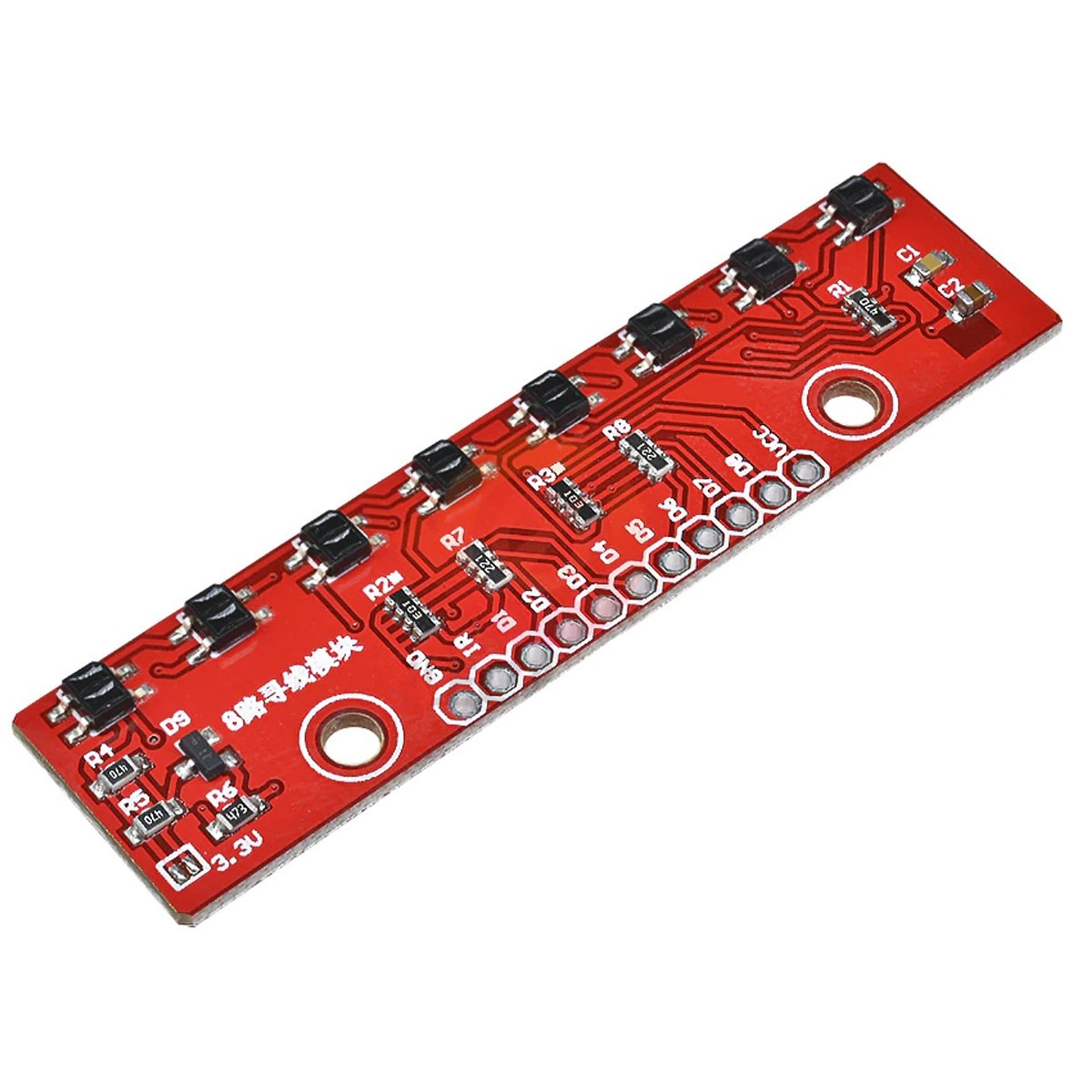
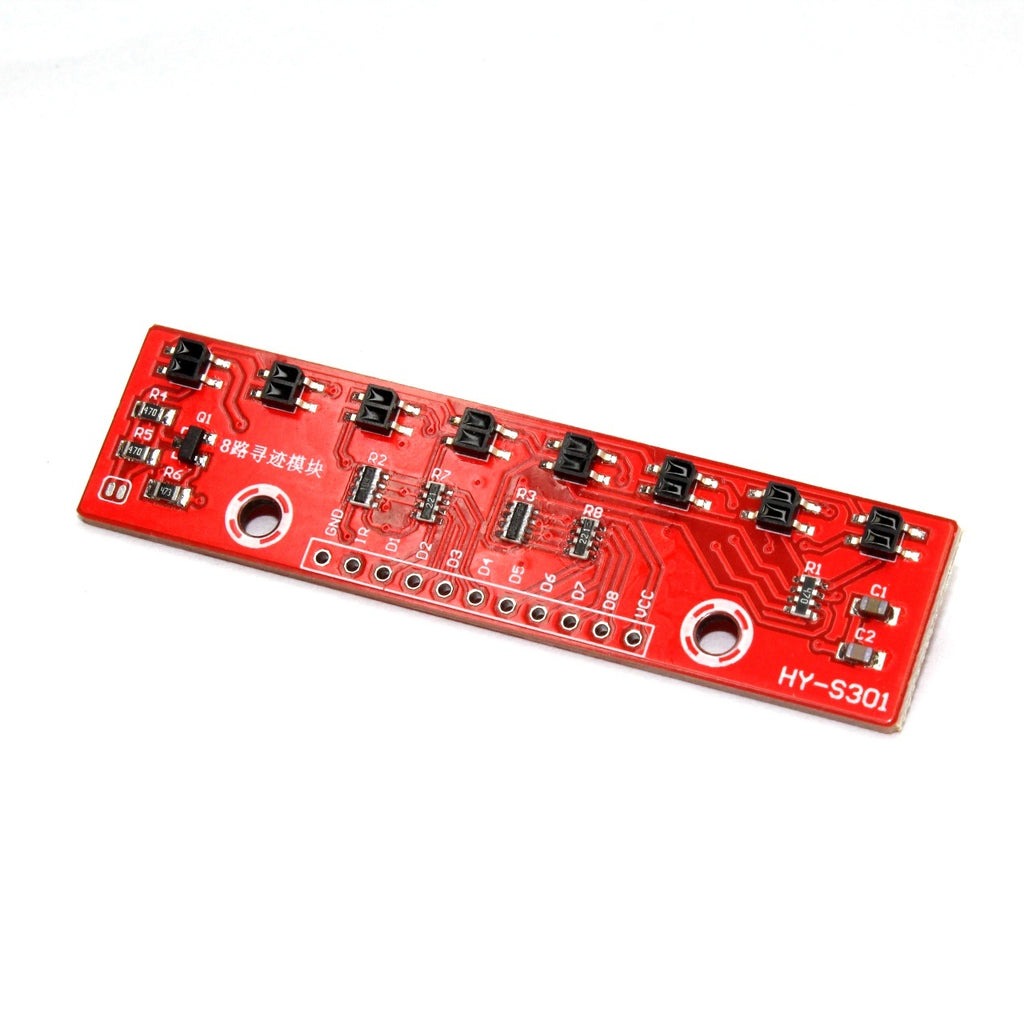

IR Line Following Reflectance Sensor Array (QTR-8RC) Overview
The IR Line Following Reflectance Sensor Array (QTR-8RC) is a compact, reliable module designed for precise line following and reflectance detection in robotics and autonomous systems. With eight infrared sensors integrated into a single board, the QTR-8RC delivers accurate position sensing and quick response for line following robots, automated guided vehicles (AGVs), research prototypes, and educational projects.
Key Features
- Eight Infrared Sensors: High coverage across a wide sensing width for robust line detection and improved positional accuracy.
- High-Precision Line Tracking: Detects contrast between lines and surfaces for smooth directional control and stable navigation.
- Adjustable Sensitivity: Easily tune thresholds to match different surface colors, reflectivity, and lighting conditions.
- Easy Integration: Compatible with Arduino and most microcontroller platforms for fast prototyping and deployment.
- Compact and Durable: Small form factor and solid construction make it ideal for tight builds, competitions, and classroom use.
- Cost-Effective: Delivers professional-level performance at an affordable price point.
How the QTR-8RC Works
The QTR-8RC uses infrared LEDs and phototransistors (or photodiodes) to measure reflectance from the surface beneath the sensor. Dark lines absorb IR light and return a lower signal, while lighter surfaces reflect more IR light and return a higher signal. By reading the eight sensor channels and comparing their values, your controller can compute the line position and steer the robot accordingly.
Sensor Output and Signal Processing
- Analog or digital readings can be read by your microcontroller depending on your wiring and firmware.
- Apply simple filtering and calibration routines to reduce noise and improve repeatability.
- Combine sensor values into a weighted average or center-of-mass calculation for smooth control.
Compatibility and Integration
The QTR-8RC is designed to work with common development platforms. Typical integration steps include wiring the sensor outputs to analog or digital input pins, powering the board from a shared supply, and using simple libraries or routines to read sensor values.
Supported Platforms
- Arduino (Uno, Nano, Mega, etc.)
- Raspberry Pi with ADC or digital interface
- ESP32, STM32, and other microcontrollers
Applications
- Line Following Robots: Build competition-ready robots that follow tape or painted lines with high accuracy.
- Automated Guided Vehicles (AGVs): Guide warehouse carts or indoor vehicles along predefined paths.
- Education and DIY: Teach students reflectance sensing, control loops, and embedded programming.
- Research and Development: Prototype navigation algorithms and sensor fusion systems.
Benefits
- Precision: Accurate line detection enables tighter control and smoother motion.
- Flexibility: Adjustable sensitivity lets you tune performance for different surfaces and lighting.
- Reliability: Effective performance in low-light and varied environments.
- Value: Professional features at an accessible price make it an excellent educational and prototyping tool.
How to Use the QTR-8RC
- Connect to Your Controller: Wire the QTR-8RC outputs to your microcontroller inputs and provide a common power and ground.
- Program the Robot: Use existing libraries or write simple code to read sensor channels and convert readings into steering commands.
- Calibrate the Sensors: Run a calibration routine over your surface to determine threshold values for dark and light readings.
- Test and Tune: Place the robot on the line and iteratively tune sensitivity, filtering, and control gains for optimal performance.
Quick Setup Tips
- Keep sensors clean and free of dust or debris for consistent readings.
- Use high-contrast tape or paint for best detection results.
- Start with conservative sensitivity settings and increase as needed.
- Apply software filtering (moving average or median) to reduce sensor jitter.
Why Choose the QTR-8RC
Whether you are a hobbyist building a first line follower, an educator teaching sensor fundamentals, or an engineer prototyping an AGV, the QTR-8RC IR reflectance sensor array offers the precision, flexibility, and value you need to get your project moving. Its eight-sensor array, easy integration, and adjustable sensitivity make it a practical choice for a wide range of robotics and automation applications.


Reviews
There are no reviews yet