
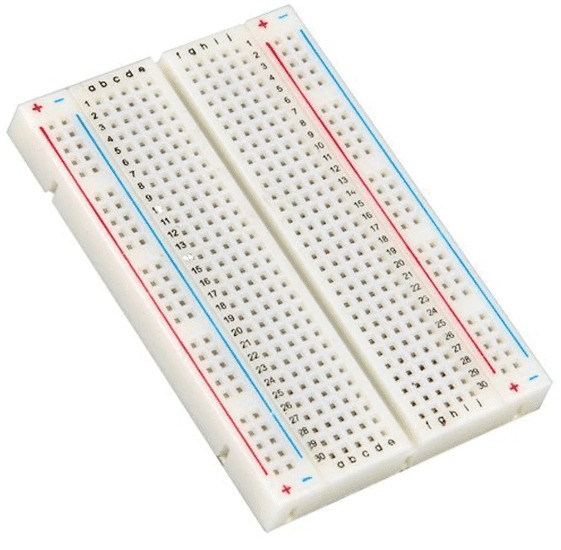
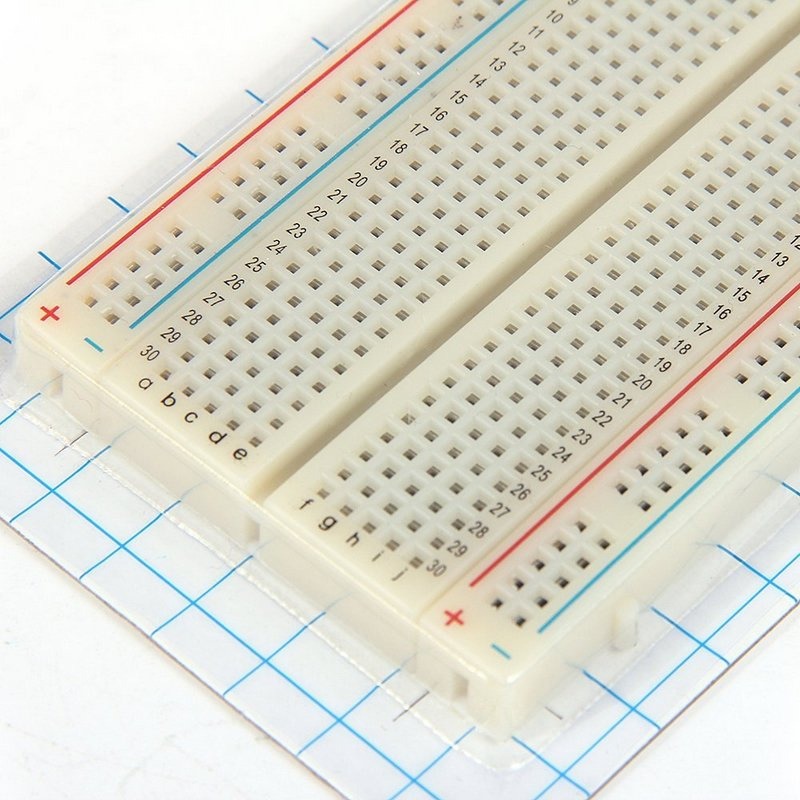
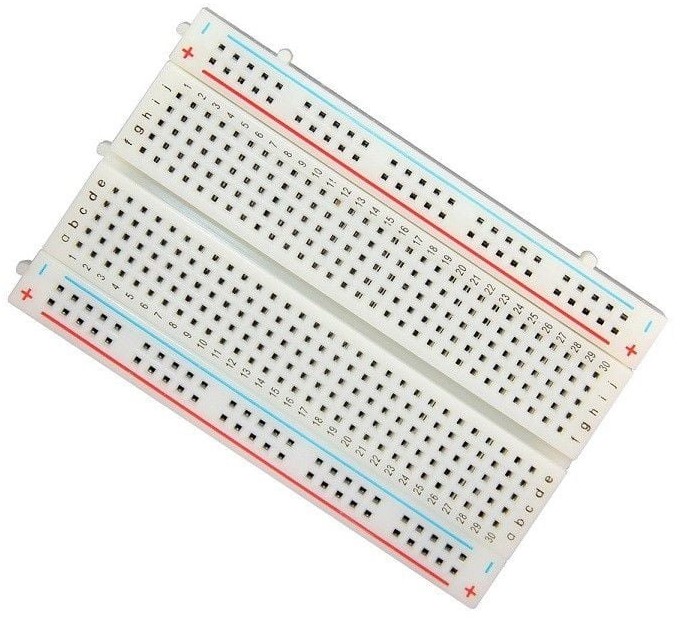
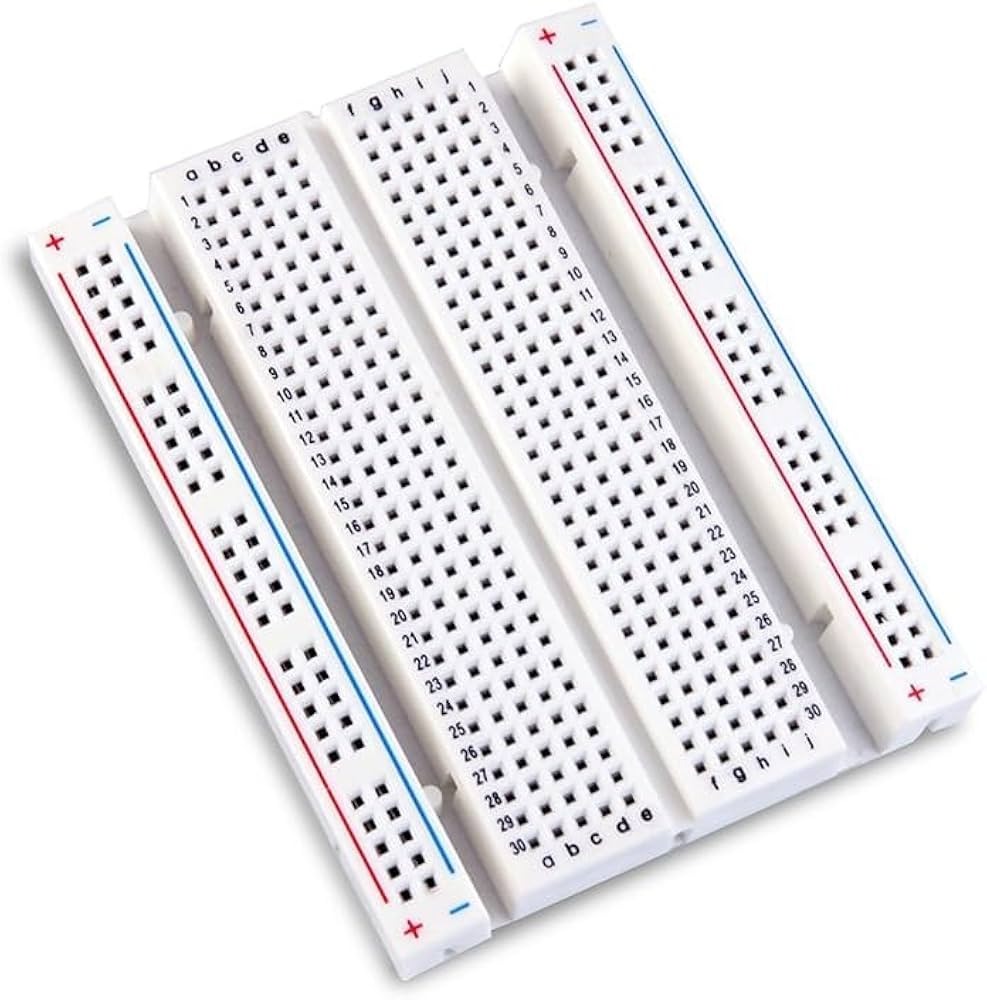

Start building your ideas with the 400 Tie Points Half Sized Solderless Breadboard. Compact and easy to use, this breadboard is perfect for electronics enthusiasts, students, makers, and engineers who want a fast, clean way to prototype circuits without soldering.
Key Features
- 400 tie points: Plenty of room for small-to-medium circuits and experiments.
- Half-sized layout: Compact 8.2 x 5.4 x 0.85 cm footprint that fits neatly on workbenches and inside project enclosures.
- Dual power rails: Power both sides of your circuit easily with two strips on each side.
- Nickel-plated phosphor bronze contacts: Secure grip for jumper wires and components for reliable connections.
- Durable ABS housing: Heat-resistant, reusable, and built to last through many prototyping cycles.
- Solderless and reusable: Change and improve your designs quickly with no soldering required.
- Broad compatibility: Works well with Arduino, Raspberry Pi, sensors, microcontrollers, and common through-hole components.
Breadboard Layout That Feels Natural
Plug in a jumper wire and feel the soft, snug click. Place a resistor and watch your circuit take shape. The standard breadboard layout gives you the freedom to focus on your idea, not the hardware.
Who Is This Breadboard For?
- Students learning the basics of electronics
- Makers and hobbyists working on Arduino projects
- Educators teaching circuit design and prototyping
- DIYers experimenting with LEDs, sensors, and resistors
- Engineers building quick test setups and proof of concepts
Product Specifications
| Feature | Details |
|---|---|
| Total Points | 400 |
| Power Rails | Dual strips on each side |
| Contact Material | Nickel-plated phosphor bronze |
| Housing Material | ABS Plastic (white) |
| Compatibility | Arduino, Raspberry Pi, sensors |
| Size | 8.2 x 5.4 x 0.85 cm |
| Reusable | Yes |
| Soldering Required | No |
Getting Started Tips
- Place the breadboard on a flat surface and identify the power rails.
- Connect a regulated power source to the rails when testing circuits that require power.
- Use jumper wires to create connections; the nickel-plated contacts hold wires securely.
- Start with a simple LED and resistor circuit to verify polarity and connections.
- When moving to a larger design, use multiple breadboards or jump to a full-size board.
Common Uses and Compatibility
- Arduino breadboard projects and prototypes
- Sensor testing with Raspberry Pi and microcontrollers
- Educational labs and classroom demonstrations
- Quick proof of concept and circuit troubleshooting
Why Choose This Breadboard for Prototyping
This breadboard offers a low-cost, low-effort way to iterate electronic designs. Its reliable contacts and compact size make it an excellent choice for learning, prototyping, and temporary circuits during the development cycle.
Note
Images are for illustration purposes only.
What comes with the 400 tie points solderless breadboard?
You get the half-size breadboard itself, ready to use. Jumper wires and components are sold separately, so add them to your order if you are starting from scratch.
- One 400 tie points solderless breadboard (8.2 x 5.4 x 0.85 cm, white ABS body)
- Two power rail strips on each side, already fixed to the board
- Nickel-plated phosphor bronze contacts fitted in the board
To complete a first circuit, pick up a few 5mm LEDs, a tactile push button switch and a BC547 NPN transistor. You can also browse our full Accessories range for more parts.
How do I choose between this half-size board and a full-size one?
Choose the 400 tie points board when your circuit is small to medium and you want it to fit inside an enclosure. Go full-size when you need many components on one board at the same time.
The 400 tie points breadboard gives you a compact 8.2 x 5.4 x 0.85 cm footprint, dual power rails and 400 tie points. That is enough for an Arduino, ESP32 or Raspberry Pi sensor setup, a few LEDs, resistors and a transistor stage. If your design grows, link two of these boards side by side or move to a larger board. The board is reusable, so nothing is wasted when you change the circuit.
Not sure which size suits your project? Tell us what you are building and we will point you to the right board.
Frequently Asked Questions
How much does the 400 tie points solderless breadboard cost?
The 400 tie points solderless breadboard is priced at Rs. 160 and is in stock. That makes it an easy add-on to any component order. Delivery is nationwide across Pakistan at a flat rate of Rs. 350, so you can combine it with LEDs, switches, transistors and other parts in one shipment.
Can I use this breadboard with an Arduino or ESP32?
Yes. The standard breadboard layout and 400 tie points work with Arduino, ESP32, Raspberry Pi, sensors, microcontrollers and common through-hole components. The nickel-plated phosphor bronze contacts hold jumper wires and component legs securely, so you can build and rebuild circuits without soldering.
Do I need to solder anything to use this breadboard?
No soldering is needed. Push component legs and jumper wires into the tie points and the circuit is made. When you want to change the design, pull the parts out and start again. The ABS housing is heat-resistant and the board is built to survive many prototyping cycles.
Where can I buy this breadboard in Pakistan?
We are College Road Electronics, an electronics shop on College Road, Rawalpindi, and we deliver across Pakistan. Order the breadboard online or visit us for project parts and guidance. Students working on school, college or university projects can ask us for help picking the right components.
Can I connect two of these breadboards together?
Yes. When a design outgrows 400 tie points, place two half-size boards side by side and bridge the power rails and signal rows with jumper wires. This keeps your build compact and lets you expand gradually instead of buying a large board straight away.





Ali Raza (verified owner) –
Ali Raza –
Abdul Momin (verified owner) –
Abdul Momin –
Tushar (verified owner) –
Tushar –
Voltron (verified owner) –
Voltron –