
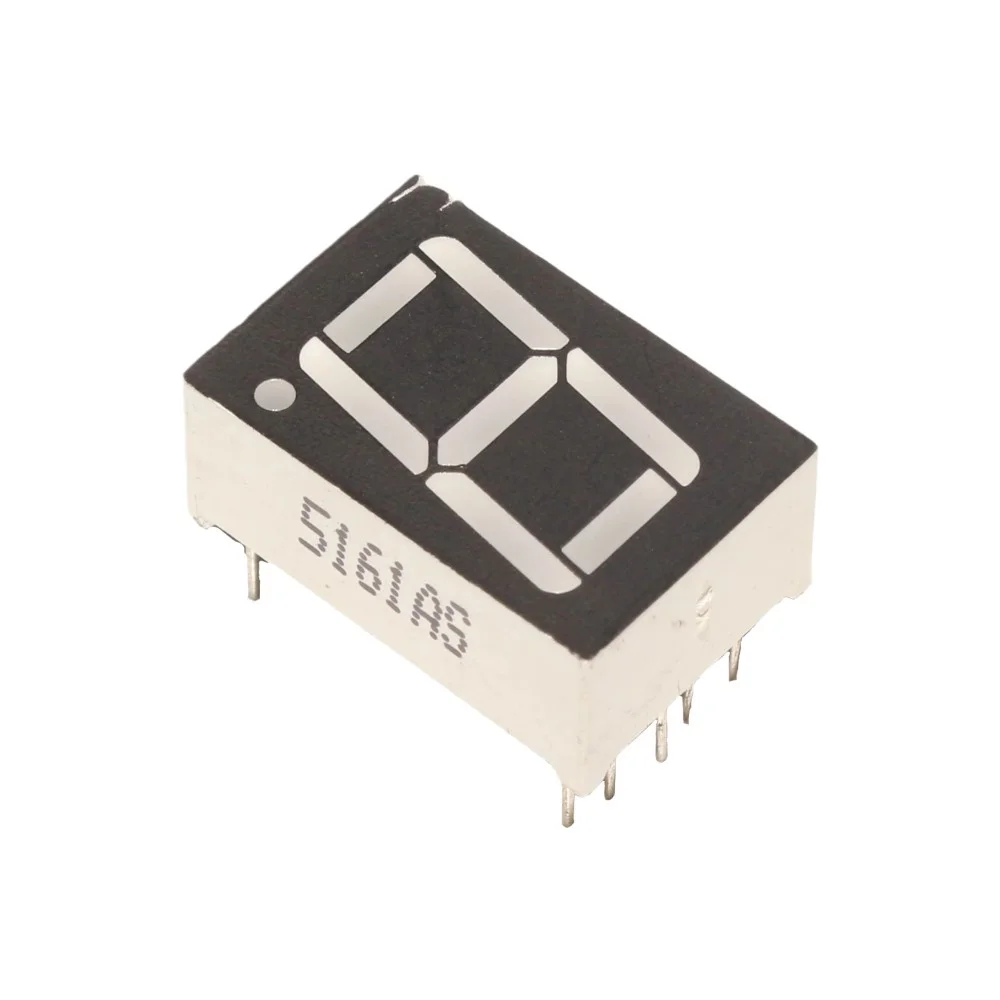

The 1-Digit 7-Segment Common Anode LED Display is a compact numeric display module used to display digits from 0 to 9 in electronic projects and embedded systems. It consists of 7 individual LED segments (A-G) and an optional decimal point (DP) arranged in a figure-eight pattern, allowing various numerical characters to be displayed by selectively illuminating specific segments.
In a Common Anode configuration, all LED anodes are internally connected together and connected to the positive supply voltage, while individual segments are controlled by pulling their cathodes LOW. This display is widely used in digital counters, clocks, timers, measurement instruments, calculators, and Arduino-based projects.
Key Features
- Single Digit Numeric Display: Displays numbers 0-9 clearly and brightly
- Common Anode Configuration: Suitable for microcontroller and digital logic applications
- High Brightness LEDs: Easy visibility in indoor environments
- Low Power Consumption: Efficient LED operation
- Compact Through-Hole Design: Easy mounting on PCBs and breadboards
- Fast Response Time: Instant illumination and switching
- Compatible with Arduino, ESP32, PIC, AVR, STM32, and other microcontrollers
- Includes Decimal Point (DP) for extended display functionality
Technical Specifications
- Product Type: 1-Digit 7-Segment LED Display
- Display Configuration: Common Anode
- Number of Digits: 1
- Number of Segments: 7 Segments + Decimal Point
- Display Color: Red (may vary depending on model)
- Forward Voltage per Segment: Typically 1.8V-2.2V
- Forward Current per Segment: Typically 10-20mA
- Mounting Type: Through-Hole
- Operating Temperature: -20°C to +70°C (typical)
- Viewing Angle: Wide-angle visibility
- Package Material: Plastic Housing
Pin Configuration
The display contains:
- 7 Segment Pins (A, B, C, D, E, F, G)
- 1 Decimal Point Pin (DP)
- Common Anode Pins
Common Anode Operation
- Connect the common pin(s) to VCC (+)
- Apply LOW (0V) to a segment pin to turn that segment ON
- Apply HIGH (VCC) to turn the segment OFF
Working Principle
The display works by illuminating selected LED segments:
- Each segment is an individual LED
- Combining illuminated segments forms numeric characters
- Example:
- Digit 0 uses segments A, B, C, D, E, and F
- Digit 1 uses segments B and C
- Digit 8 uses all seven segments
Microcontrollers can directly control segments through current-limiting resistors.
Applications
- Digital clocks
- Counters and tally systems
- Arduino projects
- Frequency meters
- Digital voltmeters
- Temperature displays
- Timers and stopwatches
- Educational electronics projects
- Embedded systems
Advantages of 7-Segment LED Displays
- Simple and easy to interface
- Bright and clear numeric display
- Low cost and widely available
- Fast response time
- Long LED lifespan
- Suitable for beginners and professionals
Usage Tips
- Always use current-limiting resistors with each segment.
- Verify the display is Common Anode before wiring.
- Use multiplexing techniques for multi-digit applications.
- Avoid exceeding the maximum forward current rating.
- Refer to the datasheet for exact pin configuration.
Note: Images are for Illustration Purposes Only.



Reviews
There are no reviews yet