
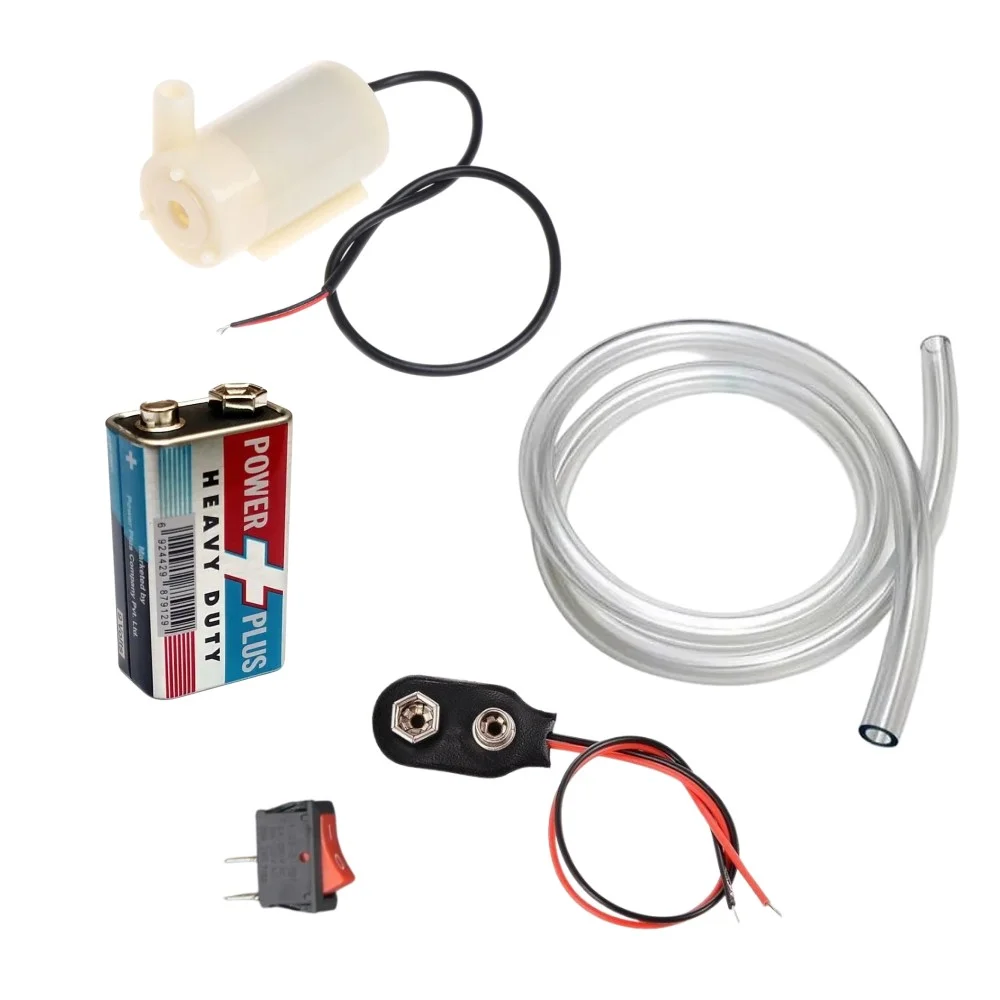

The DIY Mini DC Water Pump Science Project Kit with 9V Battery for Students is an educational electronics kit designed to introduce students to basic electrical circuits, DC motors, and water-pumping mechanisms. It allows learners to explore how electrical energy can be converted into mechanical energy to move water.
This kit is suitable for school science exhibitions, STEM learning activities, classroom demonstrations, and DIY science projects. Students can assemble and test a simple water-pumping system while developing practical skills in circuit connections, basic electronics, and hands-on experimentation.
Key Features
- Mini DC water pump for educational experiments
- Includes a 9V battery for power
- Designed for student science projects
- Helps demonstrate the conversion of electrical energy into mechanical energy
- Suitable for basic electronics learning
- Compact and easy to use in small demonstrations
- Useful for school science exhibitions
- Supports hands-on STEM education
- Suitable for DIY water circulation experiments
- Beginner-friendly project concept
Technical Specifications
- Product Type: DIY Science Project Kit
- Main Component: Mini DC Water Pump
- Power Source: 9V Battery
- Operation: Electrically powered water pumping
- Project Type: Educational electronics and science experiment
- Application: Water movement demonstrations and STEM projects
- Skill Level: Beginner / Student
- Assembly: Basic setup and connections may be required
Working Principle
The mini water pump operates using electrical energy supplied by the battery. When power is applied, the pump’s internal DC motor drives its pumping mechanism, creating movement that draws water into the inlet and pushes it out through the outlet.
This experiment helps students understand how a DC motor works as an electromechanical device and how electrical energy can be used to perform useful mechanical work.
Applications
- School science projects
- Science exhibition demonstrations
- STEM education activities
- Student electronics experiments
- Basic DC motor demonstrations
- Mini water circulation projects
- DIY educational models
- Introduction to electrical energy conversion
- Classroom demonstrations of water movement
- Beginner electronics learning
Advantages
- Encourages practical, hands-on learning
- Introduces students to DC motors and water pumps
- Helps explain electrical-to-mechanical energy conversion
- Suitable for science fairs and classroom projects
- Compact and convenient for small demonstrations
- Encourages experimentation and problem-solving
- Useful for beginners exploring electronics and STEM
Usage Tips
- Check the pump’s rated operating voltage before connecting the 9V battery.
- Confirm battery polarity and wiring before powering the pump.
- Ensure the pump inlet and outlet are connected correctly.
- Keep electrical connections and the battery dry.
- Do not run the pump dry unless its manufacturer permits dry operation.
- Use clean water for demonstrations and avoid immersing electrical connections.
- Disconnect the battery when the project is not in use.
- Adult supervision is recommended for younger students.
Package Includes
- 1 × Mini DC Water Pump
- 1ft Water Pump Pipe
- 1 × 9V Battery with Clip
- 1 x On/Off Switch
Note: Images are for Illustration Purposes Only.
What can students learn from this water pump kit?
This kit is a hands-on way to show how a battery, a switch and a DC motor work together to move water. It is aimed at beginners, so no prior electronics experience is needed.
By building and running the pump, a student can see and explain:
- How a 9V battery supplies electrical energy to a circuit
- How a DC motor turns electrical energy into mechanical motion
- How an on/off switch controls the flow of current
- How the pump inlet and outlet move water through the pipe
- Why correct polarity and dry connections matter
These points map well onto common school science exhibition topics such as energy conversion, simple circuits and water movement. The kit also pairs nicely with other beginner builds, like the Beginner STEM Kits range, if a student wants to try more than one project.
How do I set up the mini DC water pump kit?
Setup is basic. Connect the pump to the 9V battery clip through the on/off switch, place the inlet in clean water, and keep the battery and connections dry.
- Check the pump’s rated operating voltage before connecting the 9V battery.
- Confirm battery polarity and wiring before switching on.
- Attach the pipe to the pump outlet and place the inlet in clean water.
- Keep the battery, clip and switch away from water.
- Switch on, watch the water move, then disconnect the battery when finished.
Do not run the pump dry unless the manufacturer permits it. For younger students, adult supervision is recommended. If you are building a bigger moving model later, chassis options such as the 2WD Acrylic Robot Car Chassis can carry a pump and battery on board.
Frequently Asked Questions
What is included in the DIY mini DC water pump science project kit?
The package includes:
- One mini DC water pump
- One foot of water pump pipe
- One 9V battery with clip
- One on/off switch
Everything needed for a basic water-pumping demonstration is in the box, so students only need clean water and a flat surface to run the experiment.
Do you deliver this kit across Pakistan?
Yes. College Road Electronics delivers nationwide across Pakistan at a flat-rate shipping charge of Rs 350. The shop is based on College Road, Rawalpindi, and also supports students with parts and guidance for school, college and university projects.
Can this kit be used for a school science exhibition?
Yes. It suits school science exhibitions, STEM activities and classroom demonstrations. Students can show how a 9V battery powers a DC motor that moves water, which explains electrical-to-mechanical energy conversion in a simple, visible way that judges and teachers can follow easily.
Can I reuse the pump in another project after the experiment?
Yes, the mini DC water pump can be reused as long as it is handled carefully. Keep connections dry, avoid running it dry unless permitted, use clean water, and disconnect the battery when not in use. The pump can later be powered from other suitable DC sources within its rated voltage.





Reviews
There are no reviews yet