
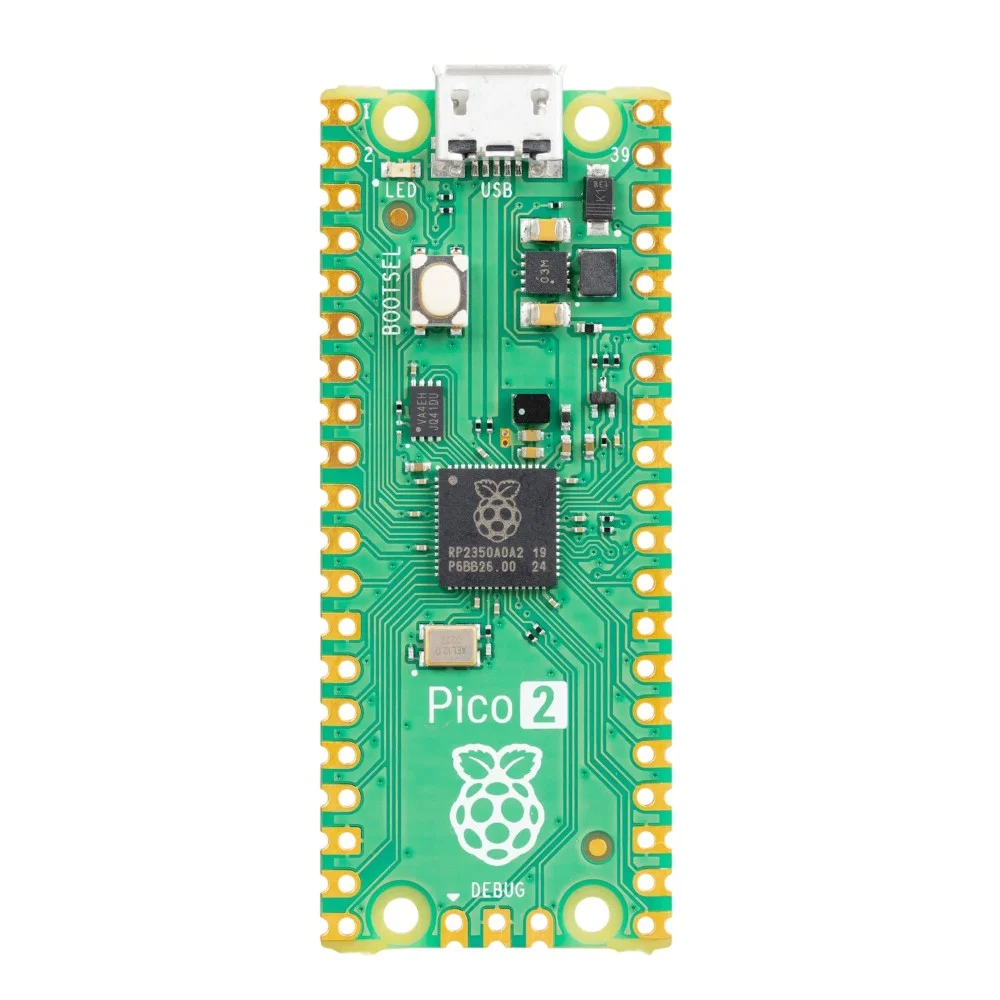
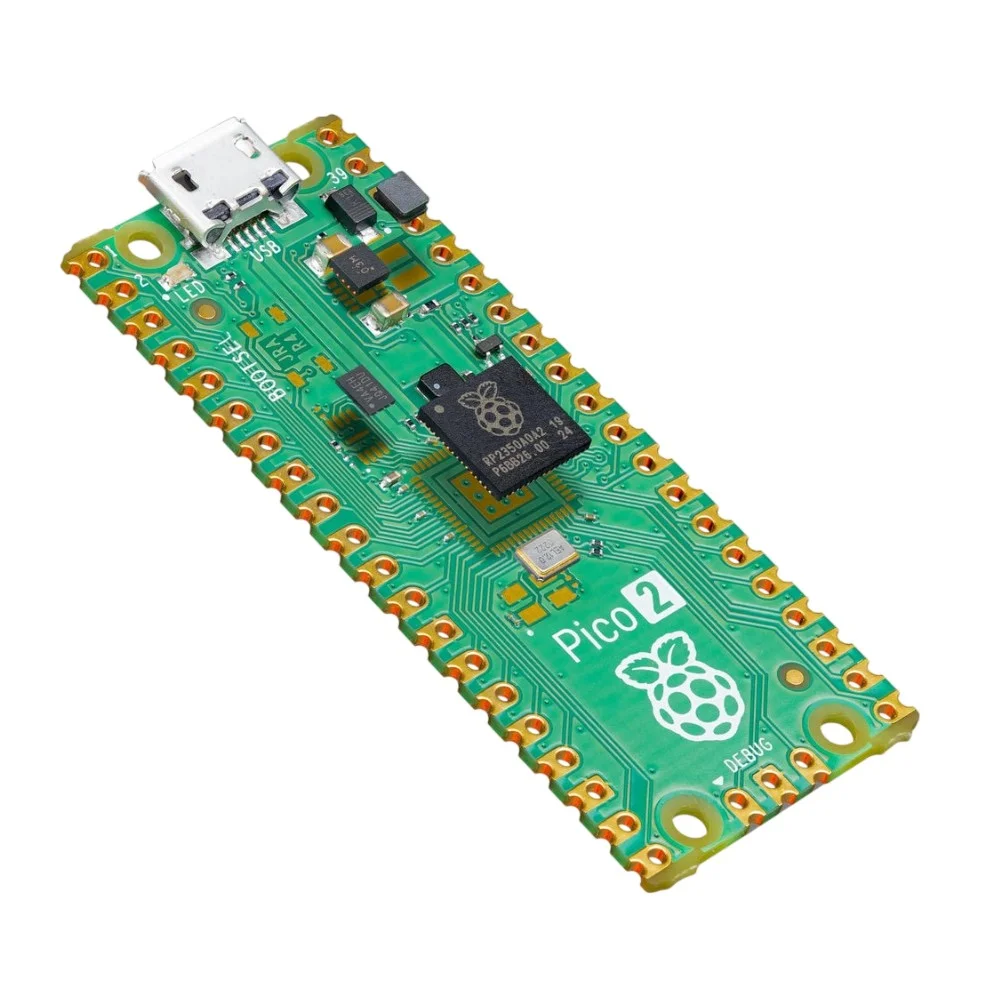

The Raspberry Pi Pico 2 RP2350 Development Board (Solderless) is a compact, high-performance microcontroller development board powered by the advanced RP2350 microcontroller developed by Raspberry Pi. This solderless version is supplied without pre-soldered header pins, making it ideal for users who want to directly integrate the board into custom PCBs or choose their own header configuration.
The Pico 2 offers a significant performance upgrade over the original Pico, featuring dual-core Arm Cortex-M33 processors (with optional Hazard3 RISC-V support), a 150MHz clock speed, 520KB SRAM, and 4MB onboard flash memory. It maintains the same form factor and pin compatibility as the original Pico, allowing existing Pico projects and accessories to be reused with minimal changes.
Supporting C/C++, MicroPython, and CircuitPython, the Raspberry Pi Pico 2 is an excellent choice for embedded systems, robotics, IoT devices, automation, data logging, sensor interfacing, and educational STEM projects.
Key Features
- Powered by Raspberry Pi RP2350 Microcontroller
- Solderless Version (Without Pre-Soldered Headers)
- Dual-Core Arm Cortex-M33 Processor (Up to 150MHz)
- Optional Dual Hazard3 RISC-V Core Support
- 520KB On-Chip SRAM
- 4MB Onboard QSPI Flash Memory
- USB 1.1 Device and Host Support
- 26 Multi-Function GPIO Pins
- 3 Analog Input (ADC) Channels
- PWM, UART, SPI, I²C, PIO, and USB Interfaces
- Low Power Sleep and Dormant Modes
- Drag-and-Drop Programming via USB
- Fully Compatible with Raspberry Pi Pico Form Factor
- Supports C/C++, MicroPython, and CircuitPython
Technical Specifications
- Product Type: Microcontroller Development Board
- Board Model: Raspberry Pi Pico 2 (Solderless)
- Microcontroller: RP2350
- CPU:
- Dual-Core Arm Cortex-M33 @ Up to 150MHz
- Optional Dual Hazard3 RISC-V Architecture
- SRAM: 520KB
- Flash Memory: 4MB
- Operating Voltage: 1.8V–5.5V
- Logic Level: 3.3V
- USB Interface: USB 1.1 (Device & Host)
- GPIO Pins: 26
- ADC Channels: 3
- PWM Outputs: 16
- UART Interfaces: 2
- SPI Interfaces: 2
- I²C Interfaces: 2
- Programmable I/O (PIO): 3 PIO Blocks with 12 State Machines
- Debug Interface: SWD
- Programming Languages:
- C/C++
- MicroPython
- CircuitPython
- Board Dimensions: Approximately 51mm × 21mm
- Header Pins: Not Included (Solderless Version)
Working Principle
The Raspberry Pi Pico 2 uses the RP2350 microcontroller to execute user programs and interact with external hardware. Programs are developed using the Raspberry Pi Pico SDK or MicroPython and uploaded through the USB interface.
The board reads inputs from sensors, switches, and communication interfaces, processes the data using its high-speed dual-core processor, and controls outputs such as LEDs, displays, motors, relays, and communication modules. The enhanced processing power, expanded memory, and improved security features make it suitable for both educational and professional embedded applications.
Applications
- Embedded Systems Development
- Arduino and Raspberry Pi Learning
- IoT Projects
- Robotics and Automation
- Home Automation Systems
- Sensor Data Acquisition
- Industrial Control Systems
- USB Device Development
- Educational STEM Projects
- Wearable Electronics
- Smart Agriculture
- DIY Electronics and Prototyping
Advantages
- Faster and more powerful than the original Raspberry Pi Pico
- Maintains compatibility with existing Pico hardware
- Supports both Arm and RISC-V architectures
- Large onboard memory for complex applications
- Multiple communication interfaces
- Low power consumption
- Compact and lightweight design
- Ideal for education, prototyping, and commercial products
Usage Tips
- Use a USB cable capable of data transfer for programming.
- Install the latest Raspberry Pi Pico SDK or MicroPython firmware before development.
- Observe the 3.3V logic level when interfacing with external modules.
- Avoid exceeding the GPIO current ratings.
- Use anti-static precautions while handling the board.
- Choose suitable header pins or sockets based on your project requirements, as this version is supplied without pre-soldered headers.

Reviews
There are no reviews yet