
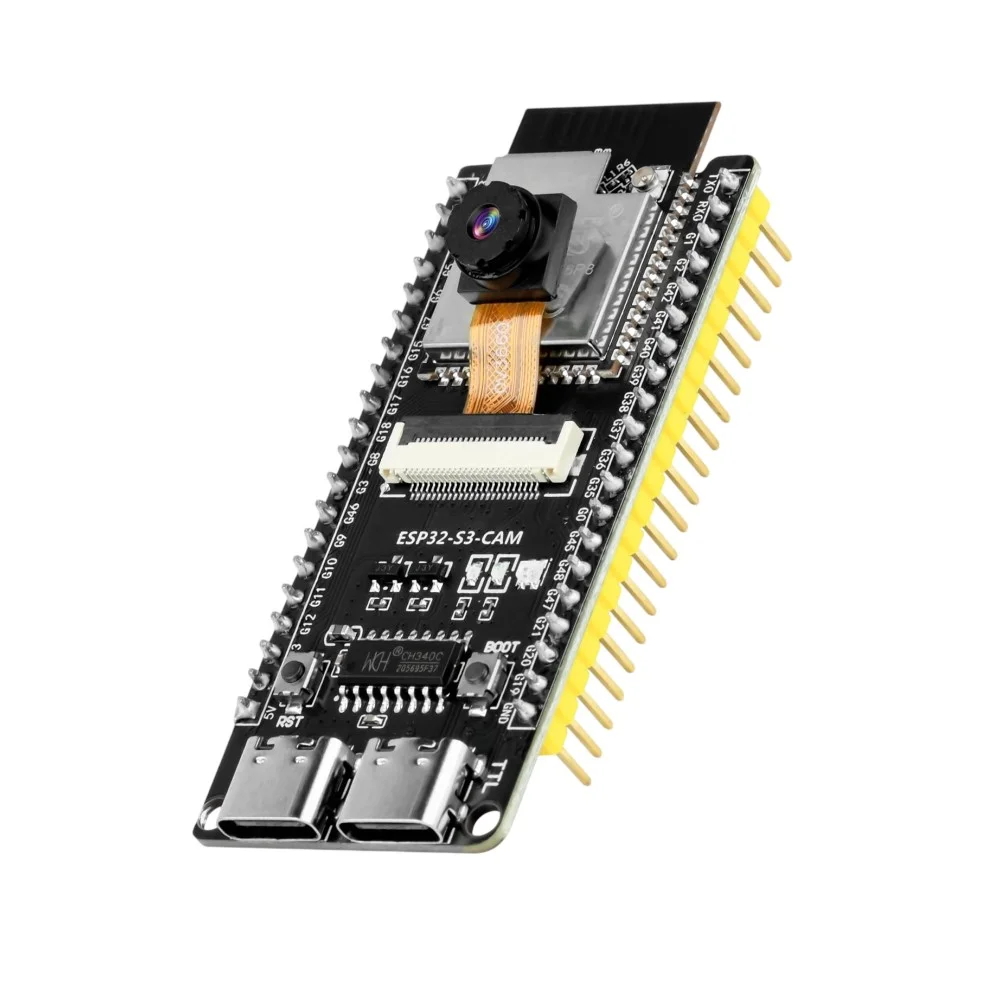

The ESP32-S3 CAM Development Board with OV3660 Camera is a powerful, next-generation AI + IoT development platform that combines the ESP32-S3 dual-core processor with a built-in 2MP OV3660 camera. It is designed for image processing, video streaming, face detection, and smart automation projects.
Compared to older ESP32-CAM boards, the ESP32-S3 version offers higher performance, more RAM (PSRAM), native USB support, and better AI capabilities, making it ideal for modern embedded vision applications.
Key Features of ESP32-S3 CAM Development Board
- ESP32-S3 Dual-Core Processor: High-performance 240MHz MCU for AI and IoT
- Built-in OV3660 Camera: 2MP image sensor for video and image capture
- Wi-Fi + Bluetooth 5: Wireless connectivity for IoT applications
- Large Memory: Typically 16MB Flash + 8MB PSRAM for image buffering
- Dual USB Type-C Ports: Easy programming and power (no external FTDI needed)
- AI Acceleration Support: Suitable for face detection and edge AI tasks
- MicroSD Card Support: Store images and video locally
- Compact and Integrated Design: All-in-one solution for camera-based projects
Technical Specifications
- Chipset: ESP32-S3 (Xtensa LX7 dual-core)
- Clock Speed: Up to 240 MHz
- Flash Memory: 16MB
- PSRAM: 8MB
- Camera: OV3660 (2MP)
- Connectivity:
- Wi-Fi 2.4GHz (802.11 b/g/n)
- Bluetooth 5 (LE + Mesh)
- USB Interface: Dual USB Type-C (OTG + Debug)
- Operating Voltage: 5V via USB
- Storage: MicroSD card slot (varies by model)
- Programming Support: Arduino IDE, ESP-IDF, MicroPython
How the ESP32-S3 Camera Module Works
The ESP32-S3 CAM board operates on a simple yet powerful principle that enables advanced image processing and AI capabilities:
- The OV3660 camera captures images/video
- Data is processed by the ESP32-S3 MCU
- Images can be:
- Streamed over Wi-Fi
- Stored on SD card
- Processed locally for AI tasks
- Results (face detection, motion detection, etc.) can trigger actions
The higher PSRAM allows smoother streaming and handling of larger image buffers, making it perfect for real-time video applications.
Applications and Use Cases
The ESP32-S3 CAM Development Board is versatile and suitable for a wide range of projects:
- Smart surveillance cameras
- Face recognition systems
- AI-based robotics vision
- IoT image monitoring systems
- Home automation (security, doorbell cam)
- QR/Barcode scanning systems
- Wildlife or remote monitoring
AI and Computer Vision Projects
- AI camera projects (face/object detection)
- Wireless CCTV prototype
- ESP32-based smart doorbell
- Remote monitoring with cloud upload
- DIY AI-powered robots
Advantages Over ESP32-CAM
The ESP32-S3 CAM offers significant improvements compared to the original ESP32-CAM:
- Native USB (no external programmer needed)
- More RAM for better image processing
- Faster CPU for AI tasks
- More stable performance for streaming
- Better compatibility with modern frameworks
Programming and Development Tips
To get the most out of your ESP32-S3 CAM Development Board, follow these best practices:
- Use good 5V power supply (camera + WiFi needs stable current)
- Use PSRAM-enabled board for image processing projects
- Start with CameraWebServer example in Arduino IDE
- Use external antenna if WiFi range is weak
- Avoid overheating in continuous streaming applications
Why Choose ESP32-S3 CAM with OV3660?
The ESP32-S3 CAM Development Board represents the next generation of embedded vision platforms. With its powerful dual-core processor, generous memory allocation, native USB support, and AI acceleration capabilities, it is the ideal choice for developers working on advanced IoT camera projects, AI vision systems, and smart automation solutions. The integrated OV3660 camera module provides excellent image quality for professional prototyping and production applications.

Reviews
There are no reviews yet