
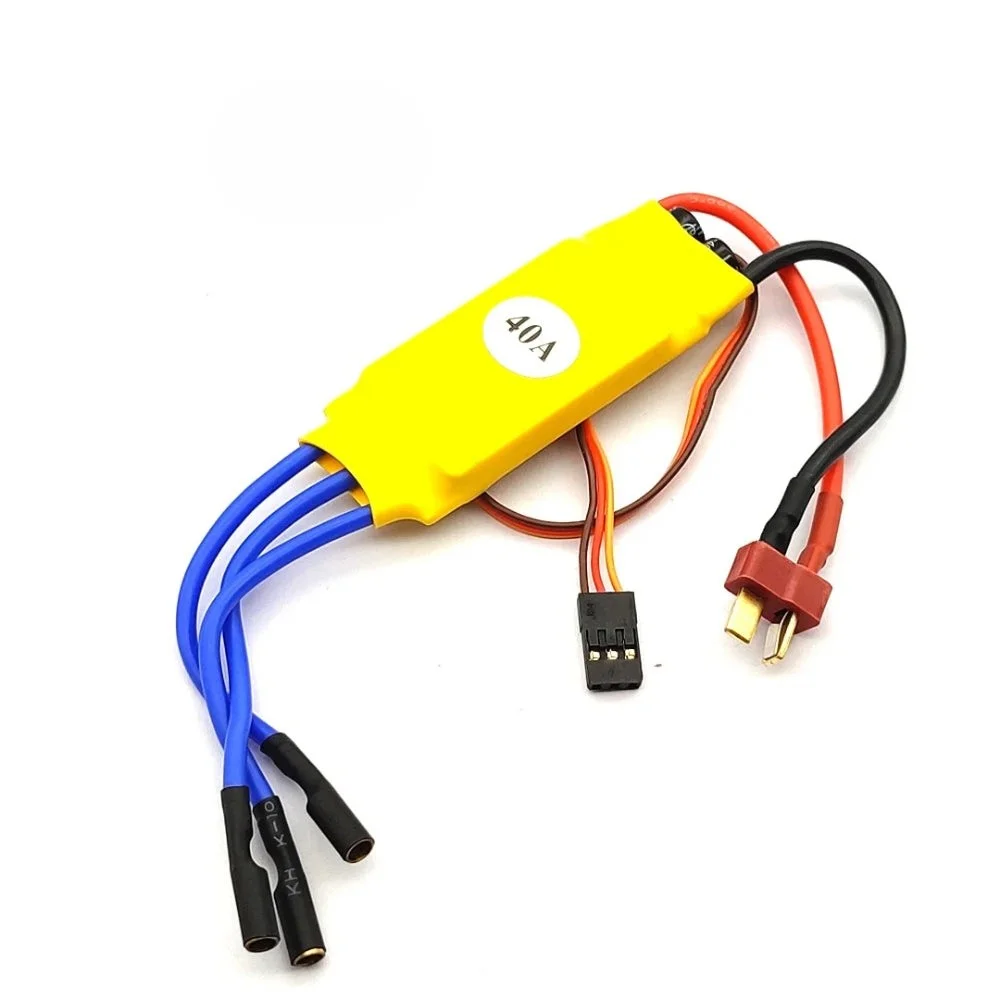

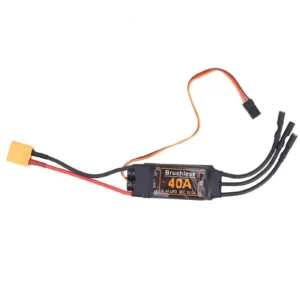
40A Electronic Speed Controller ESC for Brushless Motors
The 40A Electronic Speed Controller (ESC) is a high-performance motor control module engineered specifically for brushless DC (BLDC) motors. It efficiently regulates motor speed, direction, and braking by converting DC battery input into controlled three-phase output signals. This ESC is widely used in RC aircraft, drones, quadcopters, boats, and robotics projects, making it a go-to solution for both hobbyists and professional builders seeking reliable motor control.
Key Features
- High Current Capacity: Supports up to 40A continuous current with 55A burst capability
- Brushless Motor Support: Specifically designed for sensorless BLDC motors
- Wide Voltage Compatibility: Works with 2S to 4S Li-Po batteries (7.4V to 14.8V)
- Built-in BEC (Battery Eliminator Circuit): Delivers a regulated 5V/2A output for receivers and servos
- Fast Throttle Response: Smooth and precise speed control for dynamic applications
- Thermal Protection: Automatically cuts power to prevent overheating damage
- Over-Current Protection: Ensures safe operation under high-load conditions
- Low Voltage Cutoff: Protects Li-Po batteries from harmful deep discharge
- Compact and Lightweight Design: Easy to mount in tight spaces without adding significant weight
Technical Specifications
- Continuous Current: 40A
- Burst Current: Up to 55A (short duration)
- Input Voltage: 7.4V to 14.8V (2S to 4S Li-Po)
- BEC Output: 5V / 2A (typical)
- Control Signal: PWM (standard RC signal)
- Connector Type: May vary (XT60 / T-Plug / bare wires)
- Motor Compatibility: Sensorless Brushless Motors
- Cooling: Air-cooled with heat-shrink casing
How the 40A ESC Works
The ESC receives a PWM signal from an RC receiver, Arduino, or flight controller and converts it into the three-phase AC signals required to drive a brushless motor. By adjusting the pulse width, the ESC precisely controls motor speed:
- Low PWM signal: Results in low motor speed
- High PWM signal: Results in high motor speed
The ESC continuously monitors voltage, current, and temperature in real time to ensure safe and efficient operation throughout every session.
Applications
- RC airplanes and helicopters
- Quadcopters and drones
- RC cars and boats
- Robotics and automation systems
- DIY brushless motor control projects
Advantages of the 40A Brushless ESC
- Highly efficient power conversion minimizes energy waste
- Smooth and precise motor control improves overall performance
- Built-in multi-layer safety protections for worry-free operation
- Easy integration with RC systems, flight controllers, and microcontrollers
- Compact and lightweight form factor fits most RC and robotics builds
Usage Tips and Best Practices
- Always match the ESC current rating with your motor’s requirements before powering up
- Ensure adequate airflow and cooling during high-load or extended operation
- Calibrate the throttle range on the ESC before first use for accurate response
- Use quality connectors and proper soldering techniques on all high-current connections
- Never exceed the recommended input voltage range to avoid damaging the ESC or battery
Note: Images are for illustration purposes only.

Reviews
There are no reviews yet